
7 IELTS Writing Linking Word Mistakes That Cost You Marks
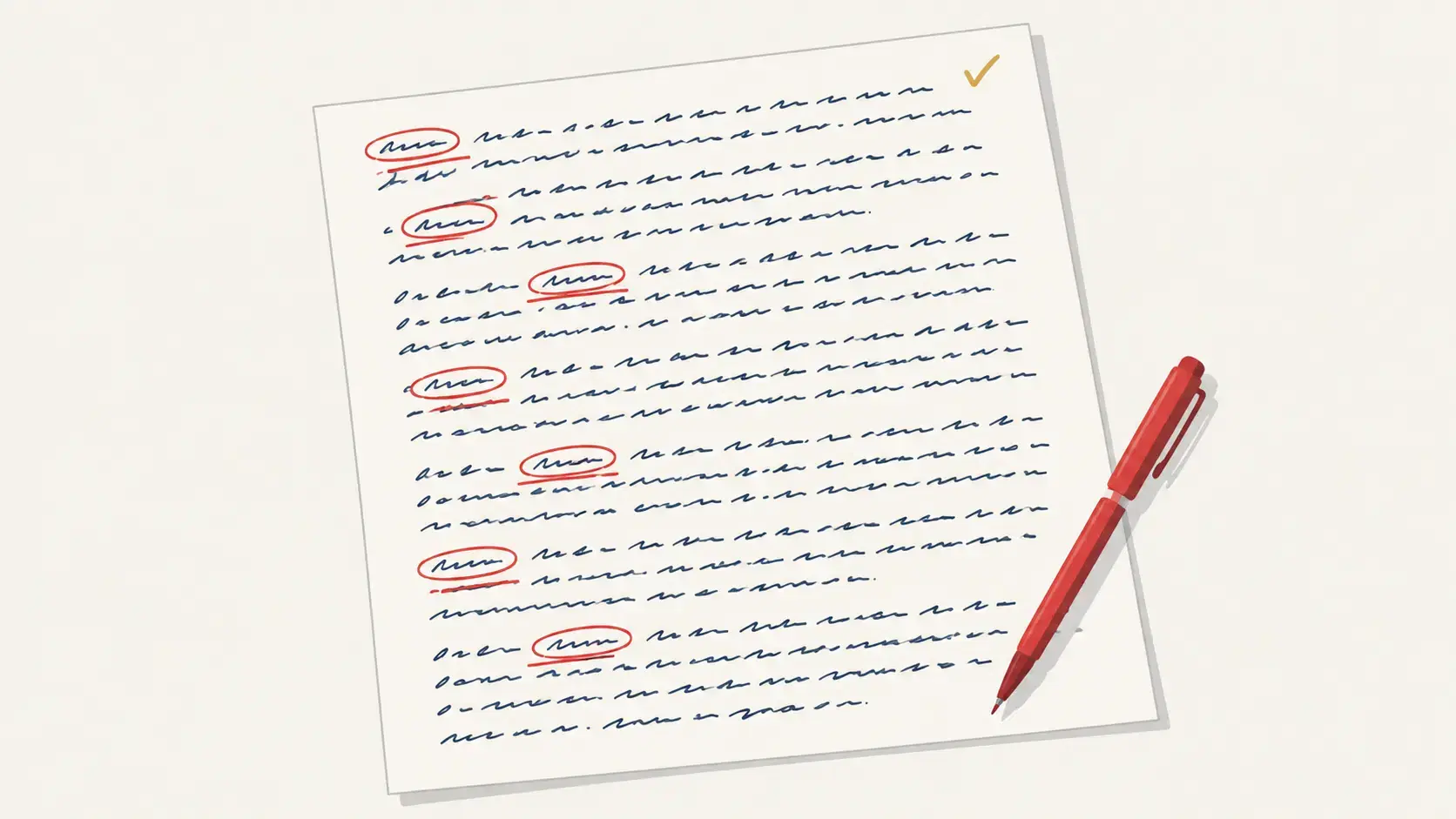
The cohesion myth that's capping your score
Ask most IELTS candidates how to improve Coherence and Cohesion, and the answer is nearly always the same: use more linking words. Firstly, Secondly, Moreover, Furthermore, In addition, Consequently - drilled into practice essay after practice essay until they appear in almost every sentence.
It rarely works, and it can actively hurt your score. Coherence and Cohesion measures whether your ideas connect logically, not how many connecting words you can fit in. An essay stitched together with 'Moreover... Furthermore... Additionally...' every second sentence often reads as more mechanical, not more sophisticated - and examiners are trained to notice the difference.
Here are seven specific ways linking words go wrong in Task 2 essays, and what to do about each one.
Mistake 1: Starting every sentence with a connector
Firstly, governments should invest in public transport. Secondly, this reduces traffic congestion. Thirdly, it also lowers pollution levels.
Each sentence opens the same way, which makes the paragraph read like a numbered list rather than a developing argument. A stronger version lets the ideas connect through meaning instead:
Investing in public transport reduces traffic congestion and, in turn, lowers pollution levels.
One sentence, no connector needed at the start, and the logical link - reduced congestion leading to lower pollution - is actually clearer.
Mistake 2: Recycling the same five 'safe' connectors
Many candidates memorise a short, comfortable list - Moreover, Furthermore, In addition, Additionally, Also - and reach for whichever one comes to mind next, regardless of what relationship it is meant to signal. Used this way, they stop meaning anything specific; they become filler that an examiner learns to read past.
Before reaching for another item from that list, ask what relationship you actually want to show - an extra point, a contrast, a result, an example - and pick language that names that relationship precisely, even if it means using the same connector twice rather than forcing in a synonym that doesn't quite fit.
Mistake 3: Using a connector that states a relationship that isn't there
University tuition fees are rising. Therefore, students should exercise more regularly.
'Therefore' promises a cause-and-effect link between the two sentences, and there isn't one - rising fees do not logically lead to exercise. A misused connector like this does not just fail to help; it actively signals confused reasoning, which counts against Coherence and Cohesion more than leaving it out would.
Before using 'therefore', 'consequently' or 'as a result', check that the second idea genuinely follows from the first. If it doesn't, either build the missing logical step into the sentence or choose a connector that reflects the real relationship, such as 'in addition' or 'at the same time'.
Mistake 4: Treating a linking word as a substitute for explaining the idea
Remote working is beneficial for employees. Furthermore, it is important for companies.
Neither sentence actually says why - the connector 'Furthermore' is doing all the work of joining two claims that are never developed. Compare:
Remote working benefits employees by removing the daily commute, and it benefits companies by reducing the office space they need to maintain.
The explanation itself - what the benefit actually is, for each side - is what earns marks in Task Response and Coherence and Cohesion together. A linking word can announce a relationship; it cannot create the content behind it.
Mistake 5: Getting the punctuation around a connector wrong
The plan however is flawed.
However people disagree about the best solution.
A mid-sentence connector like 'however' normally needs commas on both sides ('The plan, however, is flawed'), and one opening a sentence needs a comma after it ('However, people disagree...'). These are small slips, but a paragraph with several of them starts to look uncontrolled, which works against Grammatical Range and Accuracy as well as Coherence and Cohesion. It is worth learning the punctuation pattern for your five or six most-used connectors properly, rather than guessing each time.
Mistake 6: Reaching for a connector that doesn't match your essay's register
Notwithstanding the aforementioned benefits, there exist certain drawbacks that warrant consideration.
This sentence is grammatically correct, but it sits in a noticeably more formal register than the rest of a typical Task 2 essay, and it reads as if it were lifted from a memorised phrase bank rather than written for this specific question - something examiners are trained to notice. A natural equivalent communicates the same relationship without the mismatch:
Despite these benefits, there are some drawbacks worth considering.
An unusual, heavyweight connector is not automatically more advanced language - it is advanced language only when it fits naturally into what you are actually saying.
Mistake 7: Relying only on linking words and ignoring reference and repetition
Cohesion is not only about connectors - it also includes pronouns, substitution, and referring back to something already mentioned. An essay that repeats full noun phrases every time, or reaches for a connector where a simple pronoun would do the job, misses a large part of what this criterion is actually measuring:
Governments should fund public transport. Public transport reduces traffic. Additionally, public transport lowers pollution.
Governments should fund public transport, since it reduces traffic and, in turn, lowers pollution.
The second version uses 'it' to refer back to 'public transport' instead of repeating the phrase, and lets one sentence carry the whole argument - a cohesion skill that has nothing to do with adding another connector.
So how many linking words is actually enough?
There is no exact number to aim for, and chasing one is itself part of the problem. A well-organised 250-280 word essay usually needs only a modest number of explicit connectors, because most of the logical connection comes from the order of your ideas and from referring back to them - not from the connecting words layered on top. If you find yourself counting how many 'transition words' you've used, that is a sign the plan needs attention more than the vocabulary does.
A 60-second self-test for your own essay
Next time you finish a practice essay, try this before you check anything else:
- Read each paragraph and delete every linking word. Does the order of ideas still make sense on its own?
- Count how many sentences in a row start with a connector. More than two is usually a sign to rewrite one using meaning instead.
- Check each 'therefore', 'consequently' or 'as a result' - is there a genuine cause-and-effect link, or just a habit?
- Look for at least one place where a pronoun ('this', 'these', 'it') could replace a repeated noun phrase.
If your essay still reads clearly after the first step, your cohesion is coming from your ideas - which is exactly where it should come from.
Frequently asked questions
How many linking words should I use in a Task 2 essay?
There is no fixed target to hit. A well-organised 250-280 word essay typically needs only a modest number of explicit connectors, because most of the logical connection comes from how the ideas themselves are ordered and referred back to, not from the connecting words alone.
Is it wrong to start a sentence with 'However'?
No, that is a normal, natural position for it. The problem is not where a linking word sits in one sentence - it is opening several sentences in a row the same way, which makes the paragraph read like a list rather than an argument.
Should I avoid linking words altogether?
No - removing them entirely usually makes an essay harder to follow, and Coherence and Cohesion also assesses whether you can use cohesive devices accurately. The goal is using them naturally and correctly, not maximising or minimising how many appear.
What's the fastest way to check if my linking words are working?
Read the sentence without the linking word. If the logical relationship between the two ideas is still clear, the word is reinforcing a connection that already exists, which is exactly what it should do. If the sentence stops making sense without it, the connector may be papering over a gap in the reasoning itself.
See exactly where your own cohesion breaks down
Spotting these patterns in someone else's writing is one thing - seeing them in your own essay under exam conditions is harder. Zadway's AI examiner marks your Writing against the real Coherence and Cohesion criterion, flags exactly which sentences aren't connecting cleanly, and shows Band 7 and Band 8 rewrites so you can see the difference in your own words. Read the full method in our guide on how to write an IELTS Task 2 essay, see how it works, or start practising today.
See Also

Is a Longer IELTS Writing Task 2 Essay Better?
Does writing more words raise your IELTS Task 2 score? An examiner's look at word count, band descriptors, and why length is not what's being marked.
How to Write an IELTS Writing Task 2 Essay: Step-by-Step
A step-by-step method for planning, structuring and writing a strong IELTS Writing Task 2 essay, from an experienced IELTS examiner and prep teacher.

How IELTS Writing Task 2 Is Scored: An Examiner's Guide
Discover exactly how IELTS Writing Task 2 is scored across all four criteria, with real examiner insight and before-and-after essay examples.