
How to Write an IELTS Writing Task 2 Essay: Step-by-Step
Why a repeatable process beats "writing well"
Writing a strong IELTS Writing Task 2 essay is not simply a test of how well you know English. In around 40 minutes you have to understand a question, generate relevant ideas, put those ideas in a logical order, choose accurate vocabulary and grammar, and connect every sentence naturally - all at once, under exam pressure.
Trying to do all of this at the same time, sentence by sentence, is exhausting and unreliable. The candidates who score consistently well are rarely the ones with the largest vocabulary; they are the ones who have turned essay writing into a repeatable process they can run through under pressure, which frees up their attention for ideas and accuracy instead of for remembering what to do next.
This guide sets out that process step by step, so you can practise it until it becomes close to automatic.
What your examiner is actually marking
Every Task 2 script is marked against four fixed criteria - Task Response, Coherence and Cohesion, Lexical Resource, and Grammatical Range and Accuracy - each worth a quarter of your Task 2 band score. The method below is built directly around those four criteria: each step exists to help you produce writing that satisfies one or more of them.
For the full breakdown of what each criterion actually measures, read how IELTS Writing Task 2 is scored first. This guide focuses on the process of getting from a blank page to a complete, well-organised essay.
Step 1: Understand exactly what the question is asking
Before you write a single word, make sure you understand exactly what the question requires. A large number of candidates lose marks not because their English is weak, but because they write fluently about the general topic instead of answering the specific question in front of them.
Separate the topic from the task
Take this example:
Some people believe that university education should be free for everyone. To what extent do you agree or disagree?
The topic is university education. The task is much narrower - you are being asked whether it should be free, and how strongly you agree or disagree. Before you plan your essay, identify four things:
- The topic - what is this essay broadly about?
- The task - exactly what are you being asked to do with it?
- The key aspects - which specific ideas or issues does the question raise?
- Your position - if an opinion is required, what is it?
Do not start writing until all four are clear in your mind.
Step 2: Plan before you write a single sentence
One of the most common mistakes under time pressure is starting the introduction immediately. Spending three to five minutes planning first does not cost you time - it saves it, because you stop having to invent ideas halfway through a paragraph.
Your aim during planning is not to produce polished sentences. It is to build a small, useful collection of ideas you can turn into paragraphs.
Use "why" to turn ideas into arguments
Start by listing whatever comes to mind about the topic, then interrogate each item with a single question: why? Suppose the question concerns free university education. A first list might read: equal opportunity, low-income students, skilled workforce, government cost, higher taxes.
Asking why turns each note into the beginning of an argument:
- Why would free education create equal opportunity? → Students from low-income families could afford to attend.
- Why could this benefit the economy? → More people could gain professional qualifications.
- Why would it be expensive? → Governments would need to fund tuition directly instead of charging it.
A single well-developed idea, reached this way, is worth far more than a long list of ideas you never explain.
Choose fewer ideas and develop them properly
You do not need ten arguments. In fact, trying to fit too many into 250-280 words usually weakens an essay, because every idea ends up with one thin sentence instead of a proper explanation.
One strong idea, explained, illustrated and carried through to a consequence, will consistently outscore five ideas that are each only mentioned. Your task is to show that you can develop relevant ideas clearly - not that you know a large number of ideas.
Step 3: Build a short keyword map
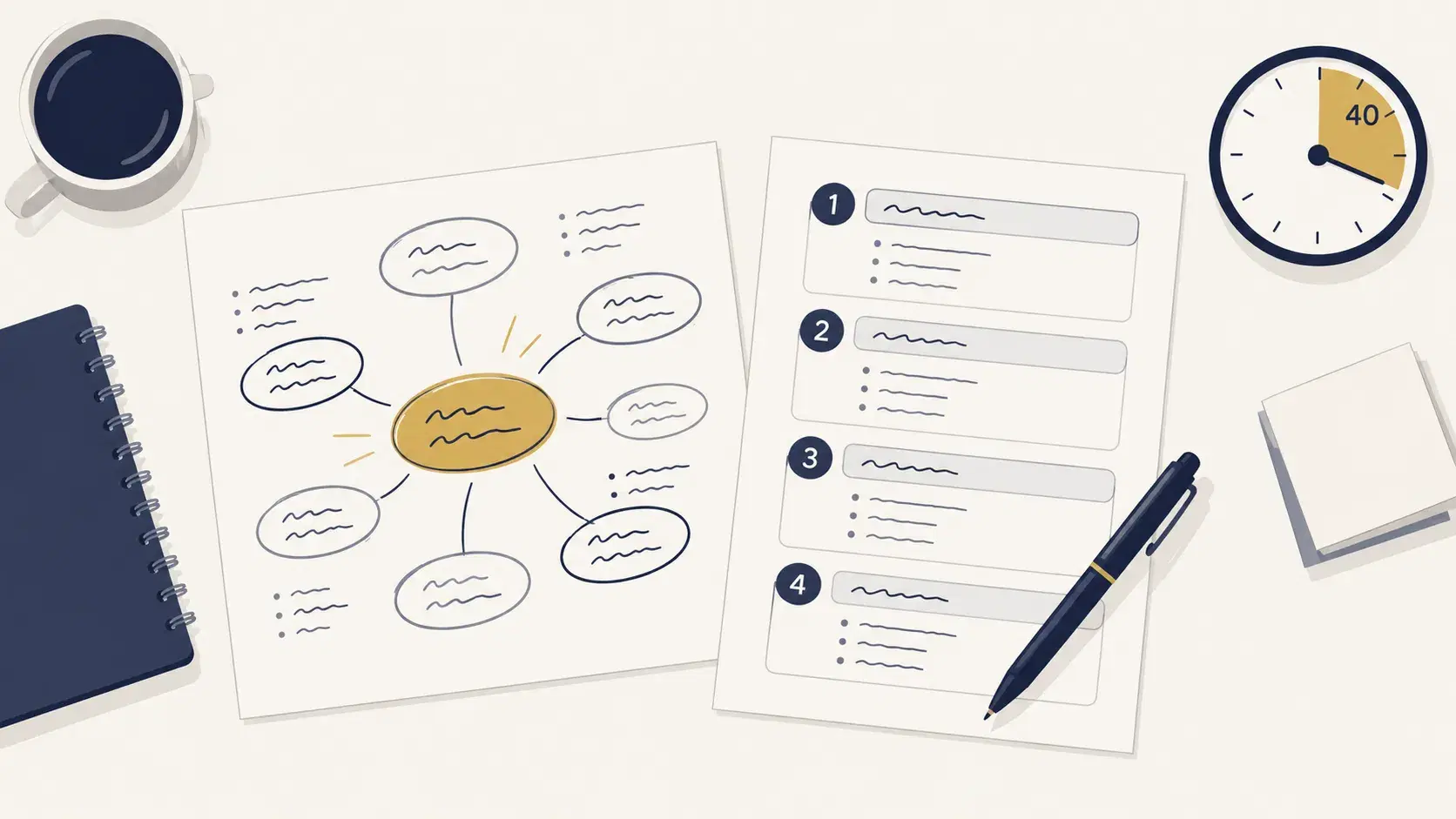
Before drafting, write down eight to fifteen keywords - the concepts that will hold your essay together. For the university funding question, that might look like:
university education · tuition fees · low-income families · equal opportunity · access to education · skilled workforce · government funding · public spending · taxation · economic development
These keywords are not sentences yet - they are a map. Chaining a few of them together, such as free education → equal opportunity → low-income students → professional qualifications → skilled workforce, sketches an entire paragraph before you have written a single full sentence, and it stops you drifting into ideas that have nothing to do with your actual argument.
Step 4: Decide your structure before you write
Once your ideas are down, decide where each one will go. Two well-developed body paragraphs are usually a safer choice than three thinner ones - each extra paragraph is another idea you need to explain, illustrate and connect, inside the same 250-280 words.
A structure you can rely on
| Section | Job |
|---|---|
| Introduction | Paraphrase the question, state your position, briefly preview your main ideas |
| Body paragraph 1 | One main idea, explained, developed, illustrated, and carried to a conclusion |
| Body paragraph 2 | A second main idea, treated the same way |
| Conclusion | Summarise your argument and restate your position |
This is a dependable shape, not a formula to memorise word for word. What you should actually learn is the logic behind it, so you can adapt it to whichever question type you are given.
Step 5: Write an introduction that does its job
Your introduction has one job: tell the examiner what your essay is about and what your answer is. It normally needs two or three moves.
Paraphrase without losing meaning
Do not copy the question. Reword it while keeping its meaning exactly intact. For example:
Some people believe that university education should be free for everyone.
could become:
There is ongoing debate over whether higher education should be provided to all students without tuition fees.
The goal is not to replace every word with a synonym - it is to show you have understood the question well enough to restate it in your own words.
State your position clearly
If the question asks for your opinion, say what it is. For example:
I largely agree that access to university education should be widened, although making it entirely free would place a considerable burden on public finances.
Your examiner should never have to guess your position from context - and a preview sentence such as 'this essay will examine both the benefits of wider access and the financial challenges of full subsidy' gives them a clear sense of where the essay is heading.
Step 6: Build each body paragraph like an argument
A body paragraph is not a set of loosely related sentences - it should read as a single, developing line of reasoning. A dependable pattern is:
Idea → Explain → Develop → Example → Result
Idea: One major advantage of expanding access to university education is that it benefits students from disadvantaged backgrounds. Explain: Tuition fees can prevent capable students from low-income families from pursuing a degree at all. Develop: Removing that financial barrier allows more students to gain professional qualifications, regardless of their family's income. Example: A talented student from a low-income household, for instance, would no longer have to choose between higher education and supporting their family financially. Result: Wider access to university education could therefore contribute to a more skilled and socially mobile population.
Notice that each sentence has a distinct job, and each one builds on the sentence before it rather than simply adding another related fact.
Step 7: Connect ideas, not just sentences
Many candidates equate cohesion with opening every sentence with 'Firstly', 'Moreover', 'Furthermore' or 'Therefore'. These words can help, but on their own they do not create cohesion - the ideas themselves need to be connected.
Compare:
University education can be expensive. Therefore, poor students may struggle to attend. Furthermore, governments can provide financial support. Moreover, this can improve employment.
with:
University education can be expensive, which can discourage students from low-income families from pursuing a degree. When capable students are priced out of higher education, the wider economy also loses potential professionals. Greater financial support could therefore allow more students to qualify and go on to contribute to the workforce.
The second version uses fewer explicit connectors, yet it is easier to follow, because each sentence grows out of the meaning of the one before it. Referring back to an idea - 'this barrier', 'these students' - does the same job, and repeating a key term is often clearer than forcing in a different synonym for the sake of variety.
Step 8: Write a conclusion that closes the argument
Your conclusion should summarise the argument you have already made and restate your position - nothing more. Do not introduce a new idea here; there is no space left to develop it properly, and an unexplained new point in the final sentences usually reads as incomplete rather than impressive.
Worked example: one idea at three levels
Here is a single Task 2 point - on whether protecting the environment is mainly an individual or a government responsibility - written at three levels of control. What improves between each version is precision and natural phrasing, not the length of the words used.
Original
Protecting the environment is important and everyone should help because pollution is a big problem.
The idea is reasonable, but 'important', 'help' and 'a big problem' are vague, and the sentence structure does not vary.
Band 7
Protecting the environment requires action from both individuals and governments, since pollution affects everyone regardless of who caused it.
The claim is now specific ('action from both individuals and governments'), the reasoning is explicit ('since... who caused it'), and the sentence uses a subordinate clause with control.
Band 8
While individual habits such as recycling make a visible difference, governments are ultimately better placed to tackle pollution at scale, through regulation that no single household could achieve alone.
'At scale' and 'through regulation' are precise, topic-appropriate phrases, the concessive opening ('While individual habits...') shows range, and the whole sentence stays fully controlled despite its length - variety and accuracy working together, rather than one substituting for the other.
Manage your 40 minutes
Task 2 gives you roughly 40 of the 60 minutes allowed for the Writing test. Spending all of it writing, with nothing left to plan or check, usually costs more marks than it saves.
| Phase | Time | What happens |
|---|---|---|
| Plan | ~5 minutes | Understand the task, decide your position, brainstorm, build your keyword map, choose your structure |
| Write | ~30 minutes | Introduction, body paragraphs, conclusion |
| Check | ~5 minutes | Re-read for errors and confirm every part of the question has been answered |
Treat this as a starting point rather than a fixed rule - the exact split should shift slightly as you find your own rhythm through practice.
Counting your words without wasting time
Most IELTS test centres now deliver the Writing test on computer, with a live word counter on screen, so tracking whether you are past 250 words takes no extra effort at all. If you are sitting a paper-based version in a market where it is still offered, build a rough sense of your own words-per-line during practice, so you can estimate your total from the number of lines rather than counting individual words in the exam itself.
Either way, the aim is not to write as many words as possible. An essay of 350 words is not automatically better than one of 270 - more words simply mean more chances to make a grammar slip, drift off topic, or repeat yourself. Aim for a length that lets you answer the task properly and still leaves time to check your work.
Common mistakes that hold candidates back
- Memorising complete essays. The question in the exam will rarely match a memorised script exactly - practise techniques and structures instead, not fixed paragraphs.
- Stacking linking words. Using 'Moreover', 'Furthermore' and 'Consequently' in every paragraph does not create cohesion on its own - the logical connection between ideas has to be there first.
- Including irrelevant ideas. Every main idea should contribute directly to answering the question, not just to the general topic.
- Writing overly long sentences. A sentence carrying four or five clauses is hard to control. If you have two clear ideas, two sentences are often stronger than one.
- Introducing a new argument in the conclusion. The conclusion should close the discussion, not open one you have no space left to develop.
- Choosing an impressive word over an accurate one. A natural, correct word will always outscore an ambitious one used incorrectly.
A five-minute self-check before you submit
Work back through the same criteria your examiner uses, rather than simply scanning for typos:
Task - Have I answered the exact question, covering every part of it, with a clear position?
Ideas - Does each paragraph have one clear main idea, explained and, where useful, illustrated?
Organisation - Is there a clear introduction, two logically ordered body paragraphs and a conclusion that connects naturally from one to the next?
Language - Is my vocabulary precise rather than just impressive? Is my grammar varied but controlled?
Length - Am I comfortably over 250 words?
Frequently asked questions
How many paragraphs should a Task 2 essay have?
Four is usually enough: an introduction, two body paragraphs, and a conclusion. A third body paragraph is fine if you have a genuinely strong third idea and time to develop it properly, but two well-developed paragraphs will always outscore three thin ones.
Is it safe to use the same essay template for every question?
The underlying logic - introduction, developed body paragraphs, conclusion - works for almost any Task 2 question. Fixed sentences memorised word for word are riskier, because examiners are trained to spot language that does not quite fit the actual task, which damages both Task Response and Lexical Resource.
How do I know my plan is good enough before I start writing?
If you can answer why, how, what does this lead to, and can I give an example for each idea on your plan, you almost certainly have enough material to write a properly developed paragraph. If you cannot answer those questions for an idea, it is usually safer to drop it before you start writing, not halfway through a paragraph.
What should I do if I am running out of time?
Finish the argument you are in rather than starting a new paragraph. A complete essay with a slightly shorter second body paragraph will generally score better than one that is cut off mid-sentence with no conclusion at all.
Put this process into practice
Reading about a method and running it under real exam pressure are different skills - the only way to make this process automatic is to practise it, essay by essay, and see exactly where it breaks down. Zadway's AI examiner scores your essay against all four Task 2 criteria, corrects it sentence by sentence, and shows you Band 7 and Band 8 rewrites of your own writing. Explore how it works, compare plans, or start practising today.
See Also

How IELTS Writing Task 2 Is Scored: An Examiner's Guide
Discover exactly how IELTS Writing Task 2 is scored across all four criteria, with real examiner insight and before-and-after essay examples.
Got Band 6? Don't Just Rebook the IELTS Test
Scored Band 6 but need Band 7? Don't just rebook the IELTS test. Learn why retaking alone rarely works, and what to fix first, examiner-style.
IELTS Vocabulary Accuracy: The Key to a High Score
Learn why IELTS vocabulary accuracy matters more than word count, and follow an examiner's step-by-step method to use words precisely across all four skills.