
How IELTS Writing Task 2 Is Scored: An Examiner's Guide

What is actually going through your examiner's mind?
Most candidates prepare for IELTS Writing by memorising vocabulary lists, rehearsing introductions and drilling essay templates. Far fewer stop to ask the question that decides their band score: what is my examiner actually looking for while they read this?
An IELTS examiner is not hunting for mistakes, and they are not scoring how impressive your essay sounds. They are working through four fixed criteria, in the same order, on every script they mark. Once you understand what each one really measures, Writing Task 2 stops feeling like guesswork and starts feeling like a skill you can train.
The four criteria, in plain English
Each criterion contributes exactly a quarter of your Task 2 band score, so none of them is optional or a 'bonus'.
| Criterion | The question your examiner is asking |
|---|---|
| Task Response | Have you answered this exact question, with ideas that are developed? |
| Coherence and Cohesion | Can I follow your argument without having to re-read it? |
| Lexical Resource | Is your vocabulary accurate, natural and appropriately varied? |
| Grammatical Range and Accuracy | Can you control a range of grammatical structures? |
The rest of this guide works through each one in turn, then shows you how they combine in a single worked example.
How the marking actually works
In Writing Task 2 you are given a topic and asked to write at least 250 words in around 40 minutes — the recommended split of the hour you get for both writing tasks combined. Whatever the question type (opinion, discussion, advantages and disadvantages, problem and solution, or a direct two-part question), the same four criteria apply.
Your examiner awards a whole or half band on each criterion, then averages the four to produce your Task 2 score, rounded to the nearest half band. There is no longer an automatic cap for a short answer, but the effect is much the same either way: an essay that falls noticeably under length is almost always an essay whose ideas are under-developed, and Task Response marks it down accordingly.
Step 1: Task Response — did you actually answer the question?
Task Response is the right place to start, because an essay written in excellent English can still score disappointingly here if it does not properly address the task. Being related to the topic is not the same as answering the question, and this is the single most common gap between a Band 6 and a Band 7 script.
Cover every part of the question
Many Task 2 questions contain more than one instruction. Take this example:
Many people believe that children should begin learning a foreign language at primary school rather than secondary school. Do the advantages of this outweigh the disadvantages?
To respond fully, you need to address the age of starting, the advantages, the disadvantages, and — crucially — give a clear view on which side outweighs the other. Writing confidently about advantages alone, however well argued, leaves part of the task unanswered and caps your score before your grammar or vocabulary is even considered.
Take a position and hold it
Where a question asks for your opinion, your examiner needs to know what that opinion is. You do not need to declare I strongly agree in every paragraph, but your argument should never leave a reader wondering which side you actually take. A position that seems to agree in the introduction and argue the opposite in the body paragraphs reads as unclear — even when each individual sentence is well written.
Develop each idea instead of listing it
This is where many otherwise strong essays lose marks. Compare:
Governments should invest more in public transport because it reduces traffic.
with:
Governments should invest more in public transport because reliable, affordable services persuade commuters to leave their cars at home, which in turn eases congestion during peak hours.
The second version takes the same claim and adds the missing why and what follows. A strong Task 2 essay does not need more ideas — it needs each idea carried through to a conclusion, rather than dropped as soon as it is stated.
Support your ideas with explanation or example
Support can come from reasoning, a consequence, or a plausible example — it does not need a real statistic to be convincing. 'For instance, a company that lets staff work from home two days a week can noticeably reduce the number of commuting journeys it generates' does its job perfectly well without inventing a data source. What matters is that the support is relevant and clearly connected to the point it is backing up.
Step 2: Coherence and Cohesion — can I follow your thinking?
Vocabulary and grammar can both be accurate and an essay can still be hard to follow, if the ideas do not sit in a clear logical order. Coherence is about that order; cohesion is about the language that signals it. Together, they decide whether your examiner has to work to understand you — and that effort counts against your score.
Give every paragraph a single job
Paragraphing is not decorative line-breaking. Each paragraph should do one thing: introduce the topic and your position, develop one main argument, develop the second, then draw the argument to a close. If a paragraph does not clearly contribute to answering the question, it usually should not be there.
Use topic sentences to signal your argument
A topic sentence tells your examiner what a paragraph is about before they read the rest of it — for example, 'One of the strongest arguments for investing in public transport is its effect on urban congestion.' The paragraph can then develop that single idea: claim → explanation → development → example or result. An examiner who always knows where a paragraph is heading can follow your argument far more easily than one working it out sentence by sentence.
Build cohesion without overusing linking words
Cohesion covers linking words, but also pronouns, substitution and natural referencing — 'this convenience' or 'private vehicles' pointing back to something already mentioned. A common misconception is that a high-scoring essay needs 'Firstly', 'Moreover', 'Furthermore' and 'Consequently' stacked at the start of every sentence. Used this way, they make an essay read like a list rather than an argument. Strong cohesion is not about adding more connectors — it is about making the relationship between your ideas unmistakable, with or without a signposting word.
Step 3: Lexical Resource — vocabulary that works, not vocabulary that shows off
Lexical Resource is IELTS's term for vocabulary, and it is the criterion most often misread by candidates who treat it as a contest to fit in the longest words available. Examiners are marking range, accuracy, appropriacy and collocation — not difficulty for its own sake.
Choose the accurate word over the impressive one
Compare:
The government should ameliorate the gargantuan ramifications of vehicular congestion.
with:
Governments should take effective measures to reduce the serious effects of traffic congestion.
The first sentence reaches for difficulty; the second communicates clearly and naturally. IELTS rewards vocabulary that does its job precisely, not vocabulary chosen to sound advanced.
Learn collocations, not just synonyms
Synonyms are rarely fully interchangeable. Significant, crucial, vital and considerable are all related to important, but swapping one in blindly does not guarantee a natural sentence — and 'make a research' is simply wrong where English requires 'conduct research' or 'carry out research'. Building real control over word partnerships, rather than memorising synonym lists, is what actually moves this score. Our guide on IELTS vocabulary accuracy works through this in detail if it is a weak point for you.
Step 4: Grammatical Range and Accuracy — variety and control, together
The name of this criterion contains both requirements. Range means using more than short, simple sentences when the idea calls for something more complex. Accuracy means controlling that complexity once you attempt it. A strong essay needs both — one without the other holds your score back.
Show range: vary your sentence structures
An essay built entirely from short sentences — 'Governments should improve public transport. It is expensive. Many people use cars.' — is easy to follow but grammatically limited. A more varied version might read: 'Although improving public transport can be costly, governments should invest in reliable systems, since doing so encourages commuters to leave their cars at home and thereby reduces both congestion and pollution.' That single sentence uses a concessive clause, a reason clause and a non-finite construction — proof that you can control structure, not just produce it.
Keep control: accuracy beats ambition
Attempting complex grammar is only worth it if you can control it. 'Although governments should improving public transport, which can helps reducing traffic, many people still prefers to use cars' is more ambitious than it is successful. 'Although governments should improve public transport to reduce traffic, many people still prefer to use cars because they are more convenient' says the same thing accurately. A simpler, correct sentence will always outscore a complex one riddled with errors.
Worked example: one idea at three levels
Here is a single Task 2 point about home working, written at three levels of control. Notice that the improvement is about precision and natural phrasing — not longer words.
Original
Working from home is good because people don't need to travel and it saves time.
The idea is understandable, but good, don't need to travel and saves time are vague, and the sentence structure never varies.
Band 7
Working from home can reduce commuting time considerably, since employees no longer need to travel to their workplace every day.
The claim is now specific (reduce commuting time), the reasoning is explicit (since... every day), and the sentence uses a subordinate clause with control.
Band 8
Remote working arrangements can significantly reduce the time employees spend commuting, freeing up hours that might otherwise be lost to daily travel.
Remote working arrangements is a precise, topic-appropriate noun phrase, significantly reduce is a natural collocation, and the non-finite clause freeing up hours... adds range without sacrificing accuracy — control and flexibility working together, rather than long words standing in for them.
What actually separates a Band 6 from a Band 7
It is tempting to think Band 6 means 'some mistakes' and Band 7 means 'no mistakes'. That is not how the descriptors work. The real difference is consistency: a Band 6 essay communicates relevant ideas but shows inconsistency somewhere — a part of the question left undeveloped, paragraphing that drifts, vocabulary that is broadly right but imprecise, or grammar that is accurate only in short sentences. A Band 7 essay holds that same level of control across the whole answer. If a Band 6 result after a retake feels familiar, our piece on what to do after scoring a 6 looks at closing that specific gap rather than simply resitting the test.
What examiners are not looking for
Knowing what does not help is just as useful as knowing what does:
- The longest word you can find. Use the most appropriate word, not the most complicated one.
- Extremely long sentences. A sentence should be exactly as long as the idea requires — no longer.
- A linking word in every sentence. Cohesion is about logical connection, not decoration.
- A memorised essay bent to fit the question. Your response has to address the actual task in front of you.
- Five ideas crammed into one paragraph. One well-developed argument consistently outperforms several that are only mentioned.
A practical self-review checklist
After you finish a practice essay, do not simply count your mistakes. Work back through the same four criteria your examiner uses.
Task Response — Did I answer every part of the question? Is my position clear and consistent? Did I develop and support my main ideas rather than just listing them?
Coherence and Cohesion — Does each paragraph have one clear job? Do my ideas progress logically? Are my linking devices natural rather than stacked?
Lexical Resource — Did I choose words for accuracy, not just effect? Are my collocations natural? Could I express the same idea more than one way?
Grammatical Range and Accuracy — Do I use a mix of sentence structures? Are my complex sentences mostly error-free? Would a simpler version of this sentence actually be more accurate?
Frequently asked questions
Do I need a perfect essay to reach Band 7?
No. Band 7 allows for occasional errors across vocabulary and grammar. What it requires is consistent overall control — a clear response, logically organised, with vocabulary and grammar that are accurate most of the time, not flawless.
Does using more linking words raise my Coherence and Cohesion score?
Not on its own, and it can lower it. Overusing connectors like 'Firstly', 'Moreover' and 'Furthermore' can make an essay sound like a list. Examiners are marking whether the logical relationship between your ideas is clear, with or without an explicit linking word.
Is it better to write more than 250 words?
A little more is sensible as a buffer against a miscount, but length is not scored directly. An essay that is comfortably over 250 words but under-developed will still score lower in Task Response than a tightly argued one closer to the minimum.
Should I memorise vocabulary or grammar structures for Task 2?
Memorised phrases can be part of your language, but leaning on them heavily is risky: examiners are trained to notice language that does not fit the question naturally, and a mismatch between a memorised chunk and the actual task damages Task Response as well as Lexical Resource.
Put this into practice
The fastest way to see exactly where your own essay loses marks against these four criteria is to have it scored the way an examiner would score it. Zadway's AI examiner gives you a criterion-by-criterion breakdown, sentence-level corrections, and Band 7 and Band 8 rewrites of your own writing — not a generic model answer. Compare plans, see how it works, or start practising today.
See Also
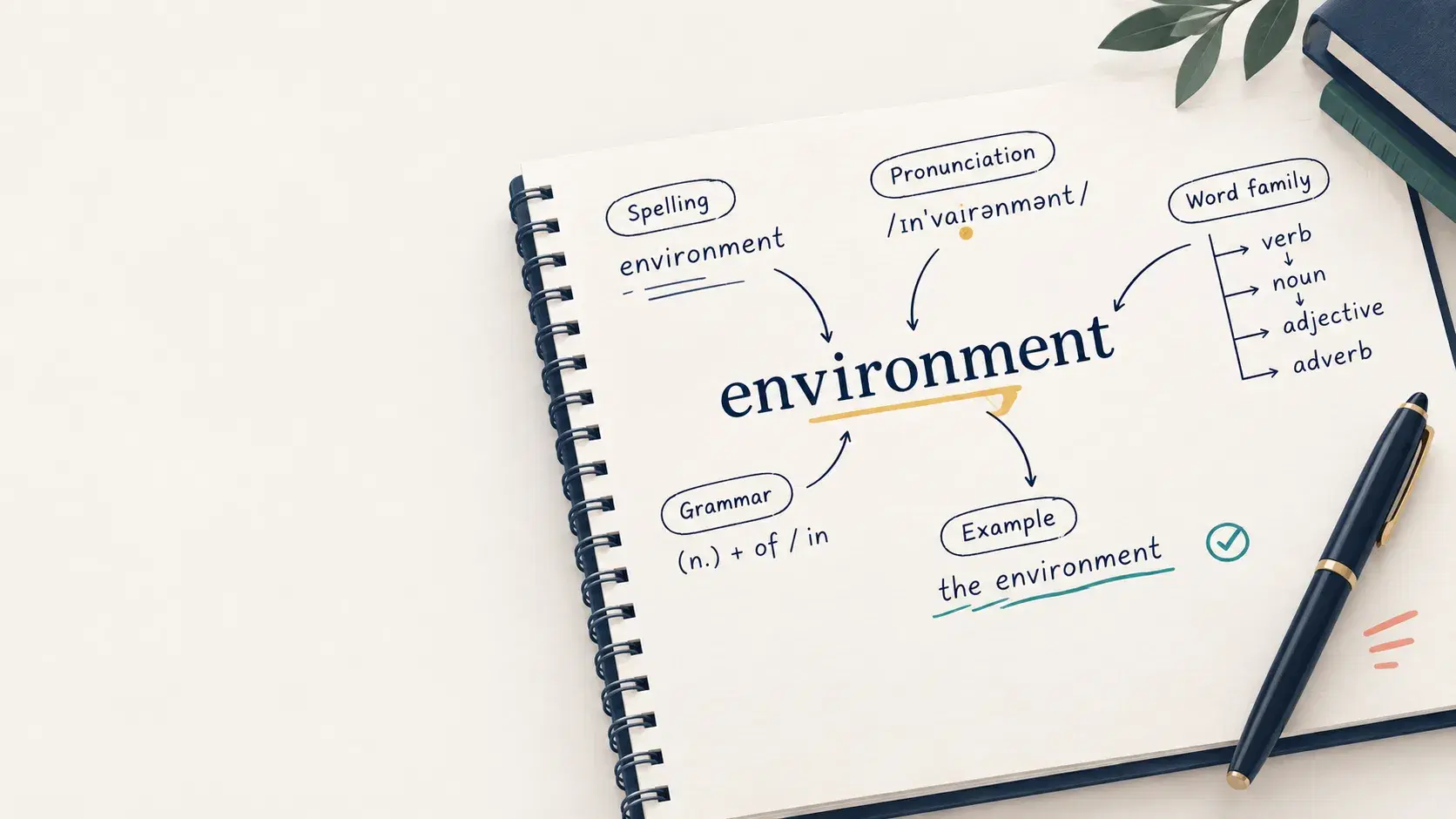
How to Learn IELTS Vocabulary Properly
Knowing a definition isn't knowing a word. An examiner's method for learning IELTS vocabulary in depth: spelling, grammar, collocation and active use.
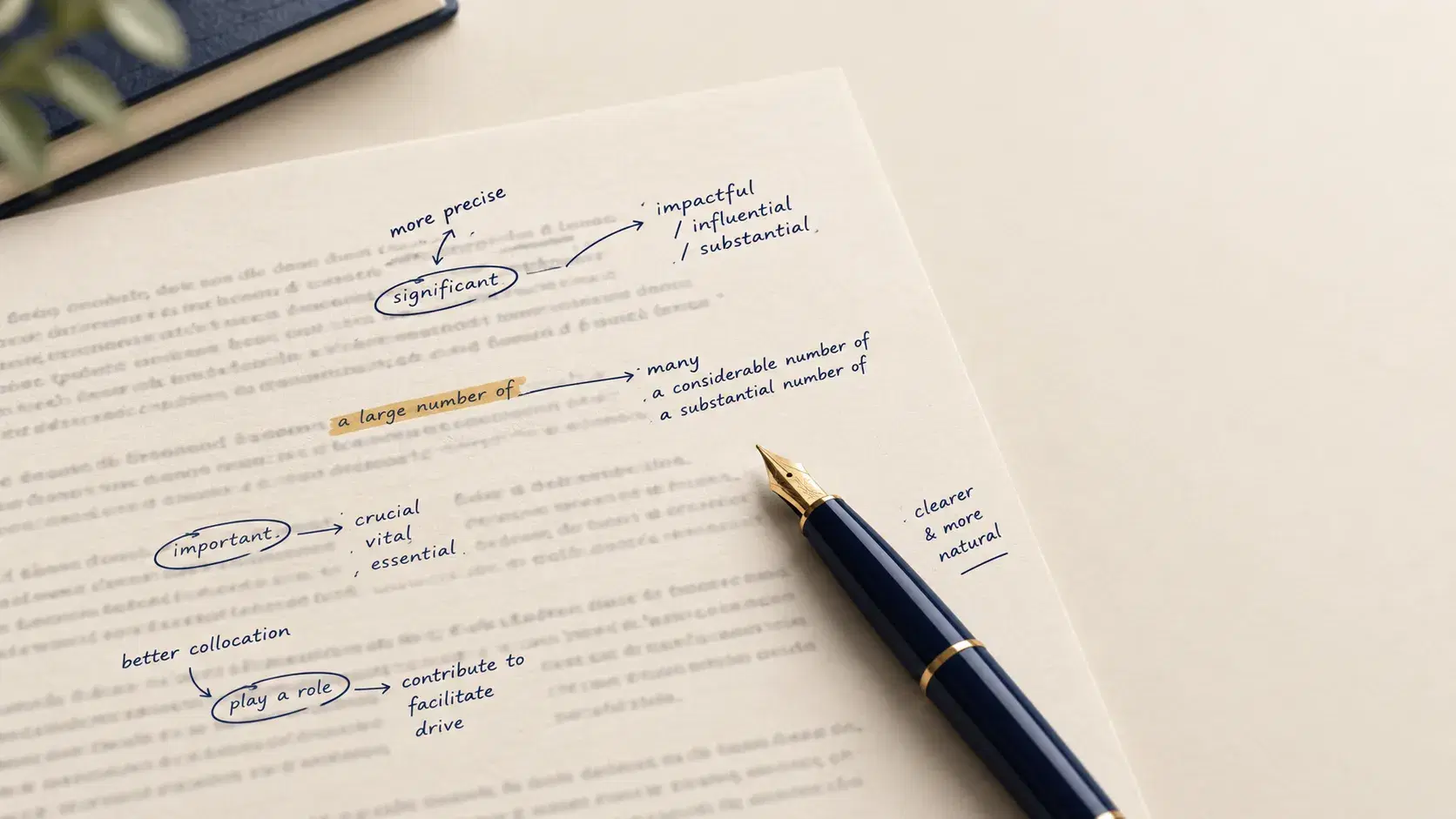
IELTS Vocabulary Accuracy: The Key to a High Score
Learn why IELTS vocabulary accuracy matters more than word count, and follow an examiner's step-by-step method to use words precisely across all four skills.
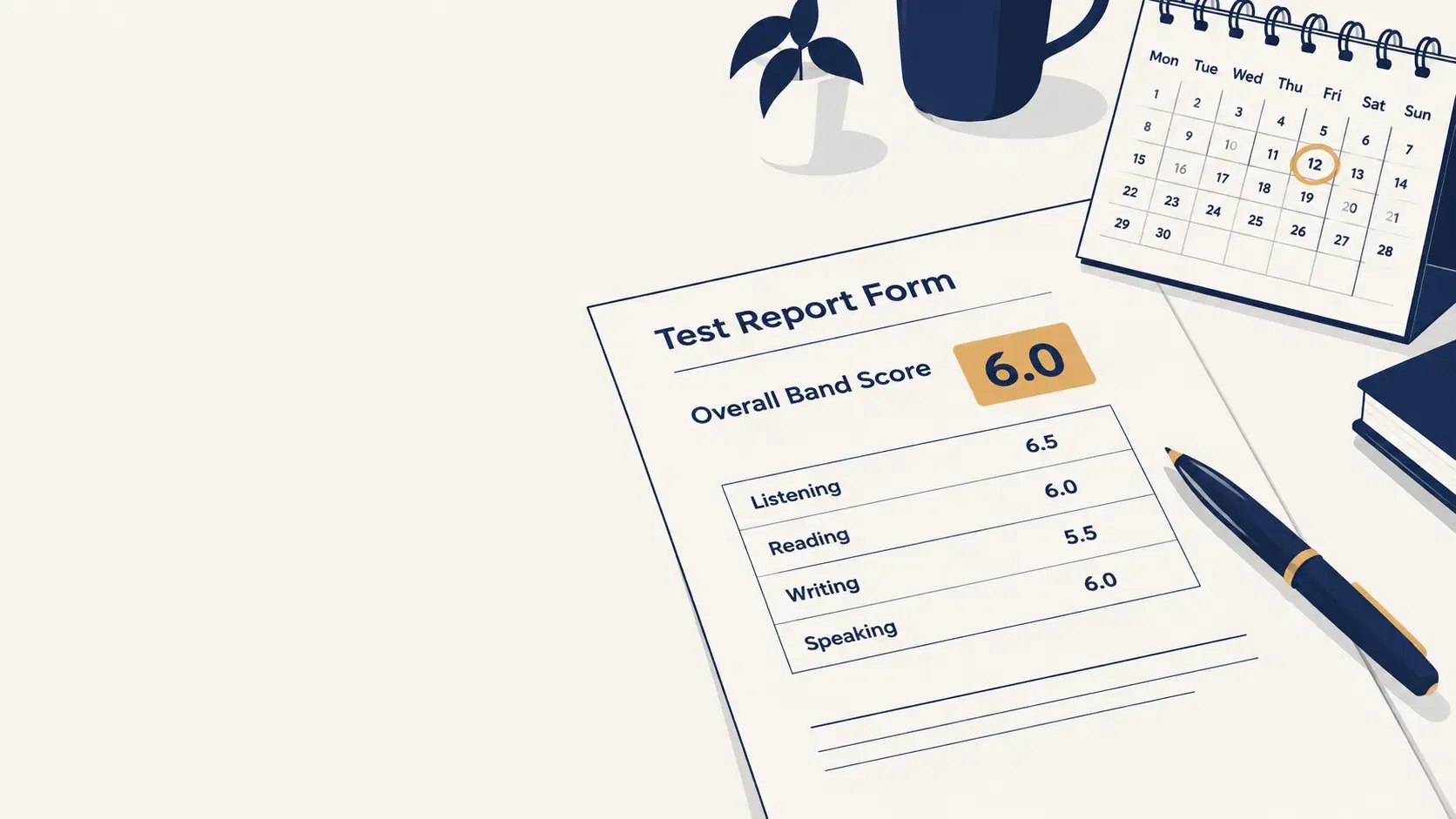
Got Band 6? Don't Just Rebook the IELTS Test
Scored Band 6 but need Band 7? Don't just rebook the IELTS test. Learn why retaking alone rarely works, and what to fix first, examiner-style.