
How to Learn IELTS Vocabulary Properly
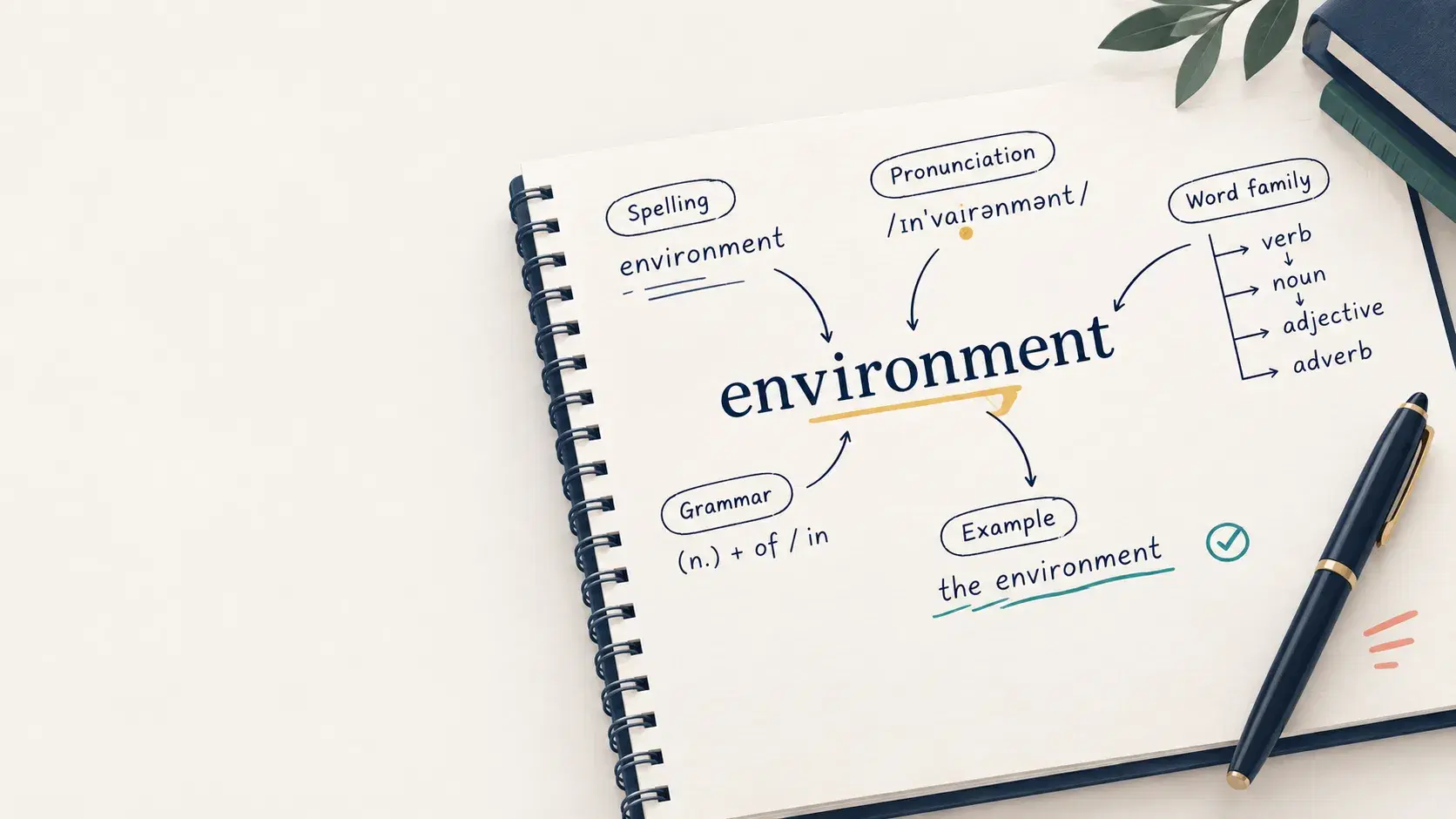
Knowing a word and owning a word are not the same thing
You already know that "significant" means "important." But can you spell it under exam pressure? Recognise it the instant a fast Listening recording rushes past it? Say it clearly enough that an examiner does not have to guess what you meant? Choose it over considerable, substantial or crucial because it is genuinely the better fit, not just the first synonym that came to mind?
That gap — between recognising a word on a vocabulary list and actually being able to use it — is where most IELTS candidates lose marks they did not know they were losing.
Why this matters across all four papers
Vocabulary is not only a Writing and Speaking concern. In Listening, an unfamiliar spelling costs you an answer you actually heard correctly. In Reading, a word you only half-know slows you down at exactly the point you need speed. A vocabulary that is genuinely known, not just recognised, supports every paper — not only the two where it is formally marked.
What the examiner — and the exam itself — actually reward
In Writing and Speaking, vocabulary is assessed under Lexical Resource, one of four criteria worth a quarter of your band score on each task. Examiners are not counting how many difficult words you use; they are judging whether your vocabulary is accurate, appropriately used and naturally combined. Reading and Listening have no vocabulary criterion at all, but both papers are built on paraphrase — the question is almost never worded exactly as the passage or recording says it, so a word you only half-know is a question you are likely to miss.
A step-by-step method for learning a word properly
You cannot learn every word in English before test day, and you do not need to. What you need is a reliable process for the words that matter — the ones that keep appearing in IELTS topics such as education, health, the environment, technology, work and urban life. Work through the eleven checks below for each new word you decide is worth learning properly.
Step 1 — Get the spelling right before you trust it
Knowing what a word means is not enough if you cannot reproduce it correctly, and this matters most in Listening, where a correctly heard, correctly understood answer can still be marked wrong for a spelling slip. Words such as accommodation, environment, necessary, government and opportunity appear constantly in IELTS material and are commonly misspelt, often because English spelling does not reliably follow pronunciation. Look, cover, write from memory, then check — this simple habit catches double letters, silent letters and irregular patterns far more reliably than reading a word several times.
Step 2 — Learn the sound, not just the letters
Pronunciation knowledge has two separate halves, and IELTS tests both. The first is recognising a word when someone else says it — you may know entrepreneur perfectly well on paper and still miss it in a fast Listening recording if you have never heard it spoken naturally. The second is producing it clearly enough that an examiner does not have to guess your meaning. For each new word, learn its syllable count, its stressed syllable and how it sounds in connected speech, not only its spelling.
Step 3 — Choose synonyms for precision, not decoration
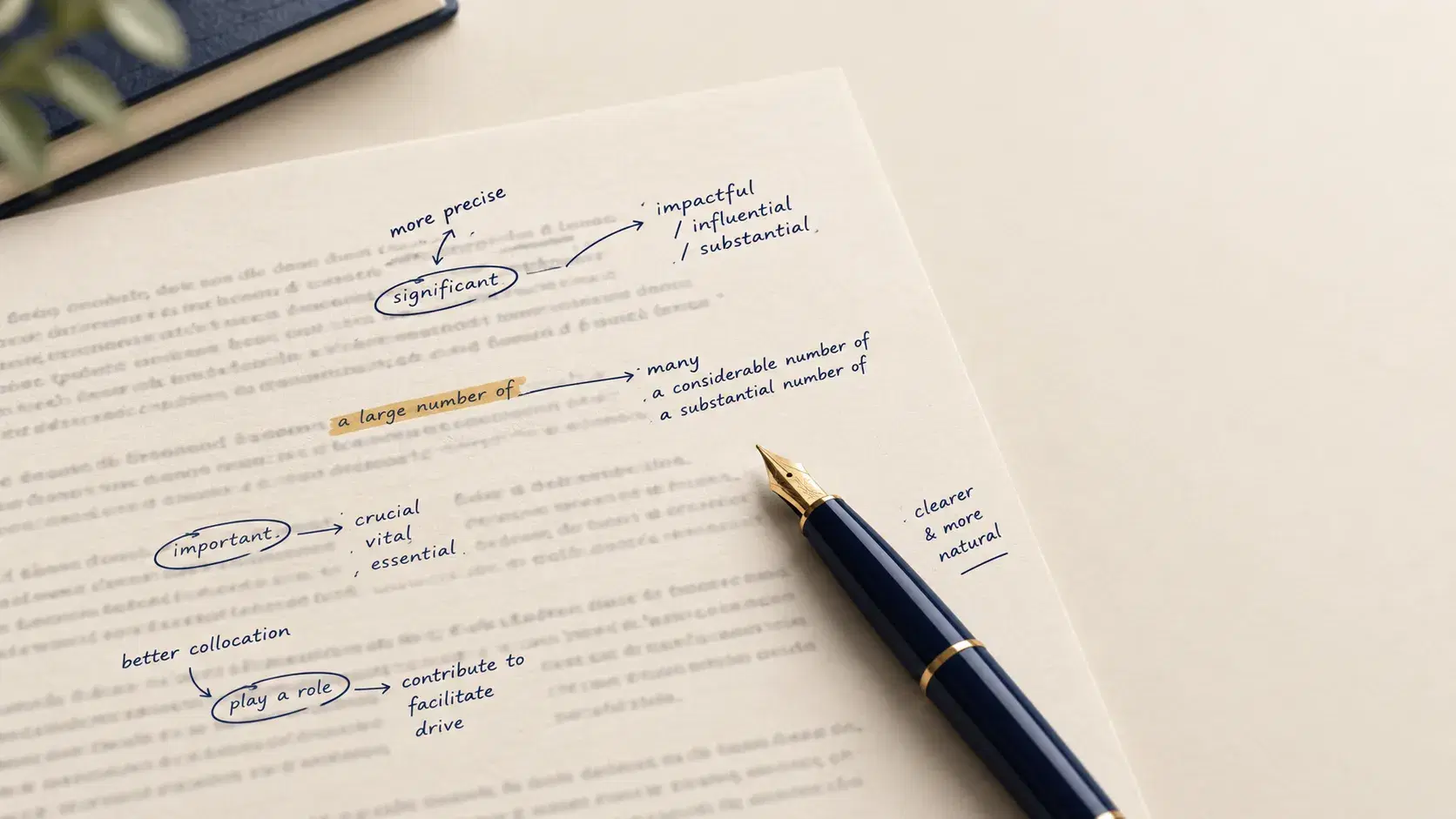
Big, large, enormous and massive all describe size, but they are not interchangeable, and neither are problem, issue, difficulty and challenge. Instead of memorising a chain like important = significant = crucial = vital, ask when you would actually use each one: important is general, significant implies a considerable effect, crucial is decisive to an outcome, vital is essential. This is semantic precision, and it matters more for your score than reaching for the longest word you know.
Step 4 — Build the whole word family
Learning develop on its own leaves you stuck the moment a sentence needs development, developed, developing or developmental. Build the family — verb, noun, adjective, adverb — for every word worth learning: affect → effect → effective → effectively, or educate → education → educational → educationally. A handful of well-built word families gives you far more usable vocabulary than a long list of unrelated words learned in isolation.
Step 5 — Learn how the word moves through time
Many candidates know a verb's base form but stumble on the forms it needs in context — a particular risk in Academic Writing Task 1, where describing a graph depends on getting trend verbs right. Rise, rose, risen, rising behave very differently from increased, which simply takes -ed. Learn the irregular forms of common trend verbs — rise/rose/risen, fall/fell/fallen, grow/grew/grown — deliberately, rather than assuming every verb follows the same pattern.
Step 6 — Learn the grammar the word demands
Vocabulary and grammar are not separate skills. Many words carry a fixed grammatical pattern that has to be learned alongside the meaning: you depend on something, not depend of it; you are interested in something, not interested on it; you avoid doing something, not avoid to do it. When you learn a new word, ask what structure normally follows it — this single habit prevents a large share of the small grammar errors that quietly pull a Writing or Speaking score down.
Step 7 — Match the word to its formality level
Not every accurate word suits every context. Kids is common and perfectly clear, but children is the safer, more neutral choice in formal writing; a lot of is fine in conversation, while a considerable amount of often fits better in an essay. This is not an argument for swapping every simple word for a complicated one — a high band score comes from vocabulary that is accurate, appropriate and natural, not from unnecessary difficulty. Precision beats complexity every time.
Step 8 — Escape the translation trap
Translation is a useful first step when you meet a new word, but it should never be the last one. If your entire knowledge of significant is a single word in your first language, you have learned one fact about it, not the word itself. Build outward from that starting point towards meaning, spelling, pronunciation, grammar, collocation and context — the difference between English word → translation and English word → meaning → context → correct use is the difference between a word you recognise and a word you can actually rely on.
Step 9 — Turn passive vocabulary into active vocabulary
Passive vocabulary is what you recognise when you read or listen; active vocabulary is what you can produce correctly, under time pressure, in your own writing and speech. IELTS specifically rewards active vocabulary, and the two do not convert automatically — a candidate can understand hundreds of advanced words on the page while still relying on the same handful when they speak. Force the conversion deliberately: after learning substantial, write two or three original sentences with it before moving on to the next word.
Step 10 — Review on a schedule, not by accident
A word learned once and never revisited fades. Build review into your routine rather than leaving it to chance: recall the word from memory a day or two after first meeting it, use it in a sentence a few days after that, then test yourself again after a week and again after two. The habit that matters most is retrieval — hiding the word and trying to recall it, or hiding the definition and trying to recall the word — rather than simply re-reading your notes, which feels like progress but builds far weaker memory.
Step 11 — Test the word across all four skills
A word is not fully learned until it holds up in Listening, Reading, Writing and Speaking. Can you recognise it spoken naturally, at normal speed? Can you understand it inside a paragraph full of other unfamiliar vocabulary? Can you use it accurately in a formal sentence you construct yourself? Can you say it without stopping to think about its meaning or pronunciation? A word that only survives on a flashcard is not yet an IELTS word.
The one-word test: twelve questions before you trust a word
Before you consider a word learned, it should pass this test:
- Do you know what it means?
- Can you spell it correctly from memory?
- Can you recognise it spoken at natural speed?
- Can you pronounce it clearly enough to be understood?
- Do you know its closest synonyms, and how they differ?
- Can you use it in an original sentence, not just a memorised example?
- Do you know the grammatical structure it needs?
- Do you know its noun, verb, adjective and adverb forms?
- If it is a verb, do you know its key tense forms?
- Do you know the words it commonly appears alongside?
- Do you know whether it is formal, neutral or informal?
- Can you use it naturally in both writing and speaking, not only recognise it on the page?
If you can answer yes to all twelve, you have learned the word. If not, you have only met it.
Worked example: one idea at three levels of vocabulary control
Here is a single Task 2 idea about remote working, written at three levels. Notice that the improvement comes from precision, word family and natural phrasing, not from switching to longer words.
Original
Many people say that working from home is good because it gives workers more free time.
Say, good and gives ... more free time are all accurate but low-precision. Every word does its job, but nothing here demonstrates range or control.
Band 7
Many people believe that remote working is beneficial because it grants employees greater flexibility over their daily schedule.
Believe replaces the vague say, and grants ... greater flexibility over is a more precise, natural collocation than gives ... more free time. Notice the grammar pattern, grant someone something, learned as part of the word rather than guessed.
Band 8
Many argue that remote working arrangements have had a significant impact on employees' work-life balance by affording them greater control over how they structure their day.
Arrangements is the word family at work: the noun form doing a job the verb cannot. Significant impact on and work-life balance are natural, topic-appropriate collocations, not decoration. Affording is a precise, formal register choice used correctly, which is worth far more than a rarer word used approximately.
Common mistakes to avoid
- Testing recognition only. Being able to recognise a word on a list is not the same as being able to produce it correctly under pressure — practise both.
- Chasing rare words while ignoring familiar ones. A candidate who cannot spell or correctly use the words they already "know" gains nothing from adding more.
- Assuming synonyms are interchangeable. A dictionary synonym is a starting point for research, not a licence to swap words freely.
- Stopping at translation. A single first-language equivalent is one fact about a word, not the whole word.
- Reviewing once and moving on. Vocabulary fades without deliberate, spaced retrieval practice.
Frequently asked questions
How many new IELTS words should I learn a day?
Fewer than you think. A small number of words learned properly — spelling, pronunciation, grammar, collocation and an original example sentence — will serve you far better on test day than a long list skimmed once and half-remembered. Depth beats volume.
Should I learn vocabulary from word lists or from reading?
Both, used for different jobs. A topic list gives efficient first exposure to the words that matter for IELTS; reading and listening to real material shows how those words actually behave, including their grammar, collocations and register, which a list alone cannot teach.
Is translation a bad way to learn a new word?
No, it is a reasonable first step and often the fastest way to grasp a word's core meaning. The mistake is treating translation as the finishing line. Build outward from it towards spelling, pronunciation, grammar and context before trusting the word in the exam.
Do I need to learn every meaning of a word, like the different senses of "address"?
Not all at once. Learn the sense you meet first, then add a new meaning to that word's entry whenever you encounter it in a different context. Trying to memorise every dictionary sense of a word in one sitting is a poor use of study time.
Put it into practice
The fastest way to find out which of your "known" words are not actually exam-ready is to write, and have the result marked in detail. Zadway's AI examiner flags word-choice, spelling, collocation and register issues at sentence level and shows Band 7 and Band 8 rewrites of your own sentences, so you can see exactly which of the eleven checks above a word is failing. For the exam-specific side of vocabulary — Lexical Resource, paraphrase and collocation — see IELTS vocabulary accuracy: the key to a high score. Or explore how Zadway works, compare plans, and start practising.
See Also
IELTS Vocabulary Accuracy: The Key to a High Score
Learn why IELTS vocabulary accuracy matters more than word count, and follow an examiner's step-by-step method to use words precisely across all four skills.
Got Band 6? Don't Just Rebook the IELTS Test
Scored Band 6 but need Band 7? Don't just rebook the IELTS test. Learn why retaking alone rarely works, and what to fix first, examiner-style.

How IELTS Writing Task 2 Is Scored: An Examiner's Guide
Discover exactly how IELTS Writing Task 2 is scored across all four criteria, with real examiner insight and before-and-after essay examples.