
Is a Longer IELTS Writing Task 2 Essay Better?

The instinct to 'write more, just in case'
A lot of Task 2 candidates treat word count as insurance. If 250 is the minimum, surely 350 is safer? It feels logical - more words must mean more evidence of ability.
It doesn't work that way. IELTS Writing Task 2 is marked against four fixed criteria, and none of them rewards length on its own. An essay that pads its way to 380 words without developing its ideas any further will not outscore a tighter, well-argued essay of 270 - and it is likely to score lower, for reasons that have nothing to do with the word count itself.
The one rule everyone agrees on: at least 250 words
This part is not in dispute. IELTS Writing Task 2 requires at least 250 words, and there is no official upper limit. Falling under 250 is a real risk worth avoiding - but clearing it comfortably, rather than by the smallest possible margin, is where most of the useful thinking about length actually stops.
Why writing under 250 words genuinely hurts you
An essay under the minimum is not simply docked a fixed number of marks - it is judged as what it almost always is: under-developed. IELTS treats 250 words as roughly the length needed to introduce a position, build two supported body paragraphs and reach a conclusion. Fall meaningfully short of that, and it is very difficult to have covered every part of the question with ideas that are properly explained, which is exactly what Task Response is marking. The short length is a symptom; the underlying problem is unfinished development.
Why writing far more than you need can hurt you too
There is no rule against a long essay, but three practical problems tend to show up once a candidate pushes well past 320-350 words:
- Less time to plan and check. Every extra sentence is time not spent thinking about ideas or catching errors - and a rushed, uncorrected finish costs more than a slightly shorter essay ever would.
- More opportunities for error. Every additional sentence is another chance to make a grammar or vocabulary slip, which counts directly against Grammatical Range and Accuracy and Lexical Resource.
- A real risk of running out of time. A candidate who is still writing the second body paragraph with two minutes left often submits an essay with no conclusion at all - and a missing conclusion is a clear, visible gap in Task Response that a few 'extra' words earlier could never make up for.
Length versus development: the same idea, two ways
Here is the same argument written twice, at a similar length, so you can see what actually changes the mark - development, not word count.
Padded, low development:
Public transport is very important. It is good for many reasons. It helps people get to work and it also helps the environment because it is better than cars. Many countries are trying to improve it. This is a good thing that should continue in the future.
Same length, properly developed:
Investing in public transport eases traffic congestion by giving commuters a genuine alternative to driving, and it reduces emissions at the same time, since fewer private vehicles are needed on the road. A city that expands its rail and bus network, for instance, can see a measurable drop in peak-hour congestion within a few years.
Both are a similar length. Only the second one actually explains and illustrates a claim - which is what separates a Band 5-6 paragraph from a Band 7 one, regardless of how many words either uses.
So what should you actually aim for?
Aim comfortably clear of 250, not exactly at it - reached by properly developing two body paragraphs, not by padding sentences to hit a number. For most candidates that lands naturally somewhere in the high-200s to low-300s. Treat that as a by-product of good planning, not a target to write towards; a well-planned essay built around one clear idea per paragraph tends to land in a sensible range on its own, without you ever needing to count while you write. Our guide on how to write an IELTS Task 2 essay sets out exactly that planning process, from brainstorming through to a finished four-paragraph structure.
Checking your count without wasting exam time
Most test centres now deliver the Writing test on computer, with a live word counter on screen, so you never need to stop and count manually - a glance tells you whether you are safely over 250. If you are sitting a paper-based version in a market where it is still offered, the more useful habit is building a rough sense of your own words-per-line through practice, so you can estimate your total at a glance rather than counting individual words during the exam itself.
Frequently asked questions
What happens if my Task 2 essay is under 250 words?
An essay under 250 words is very likely to be marked down under Task Response, because IELTS treats 250 words as roughly the minimum needed to develop a response fully. There is no separate penalty formula to calculate - a short essay is simply judged as under-developed on its own terms.
Is there a maximum word count for IELTS Writing Task 2?
No official maximum exists, but writing considerably more than you need is rarely a good trade. It eats into your planning and checking time, increases the number of errors you are likely to make, and raises the risk of running out of time before you reach the conclusion.
What word count should I actually aim for?
Aim comfortably clear of 250 - enough to develop your ideas properly with room to spare - rather than a specific target number. For most candidates that means an essay in roughly the high-200s to low-300s, reached naturally by developing two solid body paragraphs, not by padding sentences to hit a count.
Does the examiner actually count every word?
On the computer-delivered test, a live counter tracks this automatically, so the exact number is always visible on screen. What the examiner is actually assessing is whether your ideas are fully developed within that length, not the number itself.
Stop guessing whether your essay is developed enough
Word count is easy to check yourself - development is harder to judge in your own writing. Zadway's AI examiner scores your essay against all four Task 2 criteria, shows you exactly where an idea needed more support, and gives you Band 7 and Band 8 rewrites so you can see the difference development makes at a similar length. See how it works, compare plans, or start practising today.
See Also
7 IELTS Writing Linking Word Mistakes That Cost You Marks
Seven common IELTS Writing linking-word mistakes that quietly cap your Coherence and Cohesion score, with before-and-after examples from an examiner's view.
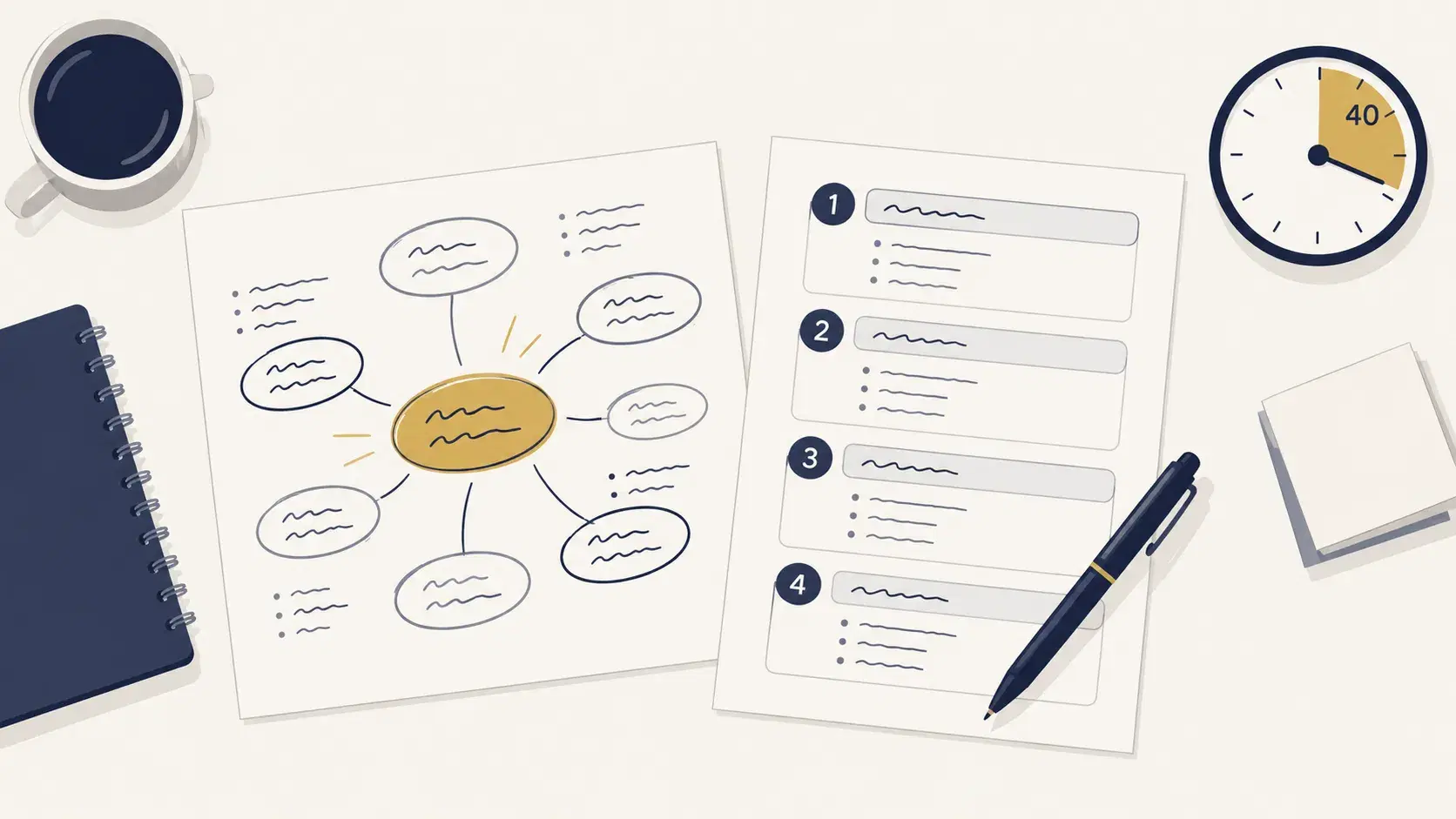
How to Write an IELTS Writing Task 2 Essay: Step-by-Step
A step-by-step method for planning, structuring and writing a strong IELTS Writing Task 2 essay, from an experienced IELTS examiner and prep teacher.
How IELTS Writing Task 2 Is Scored: An Examiner's Guide
Discover exactly how IELTS Writing Task 2 is scored across all four criteria, with real examiner insight and before-and-after essay examples.