
How to Improve Your IELTS Listening Skills Through Practice
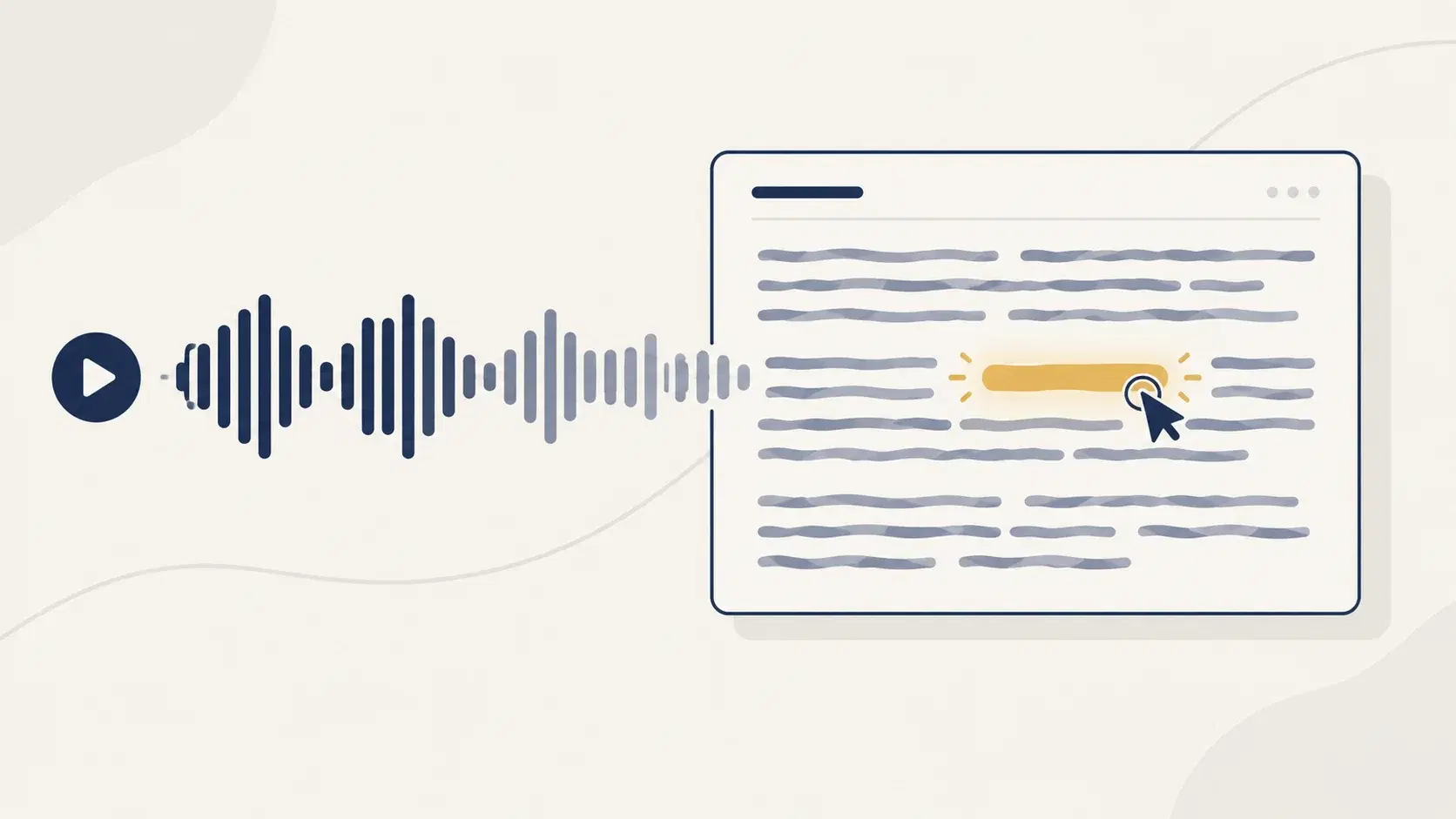
This case study looks at Zadway's Listening practice drills, and in particular transcript mode: the practice-mode tool that lets you read along with a recording and look up any word in it without leaving the session.
The challenge: plenty of listening, very little improvement
Many IELTS candidates believe the best way to improve Listening is simply to listen to more English. Regular exposure certainly helps, but there is a real difference between listening to English and practising your listening skills.
Play a recording, understand about 60% of it, then move straight on to another, and you may have enjoyed the session without fixing a single reason you struggled. Effective practice needs patience, repetition, vocabulary building and close attention to how English is actually spoken.
A familiar scenario (illustrative, not a single real candidate)
The candidate below is a composite of habits that recur across IELTS learners, not a named student. They listen to English for an hour most evenings, mixing interviews, lectures and podcasts. Their reading vocabulary is strong. Yet in practice Listening tests they keep dropping marks on answers they recognise instantly when they see them in the audio script afterwards.
The words were not unknown. They were simply not recognised when spoken.
Why knowing a word is not the same as hearing it
One of the biggest mistakes in vocabulary learning is studying only the written form of a word. You can know exactly what a word means on paper and still fail to recognise it when somebody says it, because written English and spoken English do not always look or sound the same. A familiar word can sound surprisingly different in natural speech.
This matters more in IELTS Listening than almost anywhere else. The recording is played once, nobody will repeat a sentence for you, and the test moves from everyday conversations in Parts 1 and 2 to denser academic talk in Parts 3 and 4. Our guide to how to score high in the IELTS Listening test covers the exam techniques; this article is about the practice habit that makes them work.
Why more hours of listening do not close the gap
Passive listening never tells you which words and sounds are getting past you. You keep meeting the same problem and moving on. What closes the gap is a deliberate loop:
Listen → identify the problem → check the transcript → learn the word → listen again.
You are no longer just consuming English. You are repairing a specific weakness in your listening.
The method: listen, investigate, learn, listen again
This method works with any audio that comes with a reliable transcript, whether it is a lecture, an interview or a documentary. It works best on material designed for IELTS practice, where the recording, the questions and the transcript all belong together. The steps below are the ones examiners and teachers recommend most often.
Step 1: Listen first, without the transcript
Try to understand the speaker with no written support. Resist the temptation to keep the transcript open from the start, because that trains you to read subtitles rather than to understand speech. If you hear something you cannot catch, do not simply swallow it and carry on. Make a note of roughly where it happened.
Step 2: Investigate what you missed
Find the exact part in the transcript and study it. Suppose the speaker says:
"...the city has excellent public transport for commuters..."
You understand the general sentence but do not recognise the word commuters. Instead of ignoring it, find it in the transcript and ask:
- What does the word mean?
- How is it pronounced, and where is the stress?
- What does it sound like in natural speech?
- How is it used in this particular sentence?
- Are there related forms of the word you should know?
One moment of confusion has become a learning opportunity.
Step 3: Learn the meaning and the sound together
When you discover a word during listening practice, learn the meaning + the pronunciation as one unit. A useful vocabulary entry looks like this:
- Word: commuter
- Meaning: a person who regularly travels between home and work
- Pronunciation: how the word actually sounds, with the stress in the right place
- Example: Many commuters use public transport.
- Related words: commute, commuting
Over time, thousands of these small connections between word, sound, meaning and use make a real difference. Our guide to how to learn IELTS vocabulary properly shows how to build entries like this without them turning into a list of translations.
Step 4: Go back to the nearest point, then start again from the beginning
After you have investigated a word, do not restart the whole recording. Go back to a point shortly before the sentence, listen again, and pay attention to how the word is pronounced and how it fits. Repeat as often as you need, and try to recognise the word without looking at the transcript. Then carry on.
When you reach the end, return to the start and listen once more without the transcript. Parts that were hard the first time will now be easier, and you may notice new words you missed before. That is normal. Stop, investigate, learn, and repeat until you can follow the whole recording comfortably.
It sounds slow, and it is. But slow, focused practice is worth far more than hours of English you only half understand.
How Zadway's Listening practice drills support each step
The method above is simple to describe and awkward to carry out with scattered tools: audio in one tab, a transcript somewhere else, a dictionary in a third. Zadway's Listening practice drills bring the recording, the questions, the transcript and the vocabulary into one place, so each stage of the loop is a click rather than a detour.
A recording you control in practice mode
Each drill gives you an audio player and a question navigator, with a short description of the recording above them. In practice mode you can pause, drag the progress bar back to just before the sentence you missed, and replay a finished recording from the top. That makes the go back to the nearest point step effortless, and you can check each answer as you go before you submit the whole set.
Transcript mode: read along without losing your place
Under the audio player you will see the prompt "Finding it hard to keep up? Read the transcript and learn the words." Select Switch to transcript mode and the question area is replaced by the full transcript, speaker by speaker, while the audio player stays right where it was. Read along, replay a difficult stretch, and switch back to the questions when you feel confident. The questions and your answers are still there when you return.
Look up any word in one double-click
In transcript mode, double-click any word (or long-press it on a phone) and its entry opens over the transcript, without taking you out of the session. Depending on the word, you will see its meaning, part of speech, band level and phonetic spelling, plus a recording so you can hear how to say it. That is step 3 of the method, meaning and sound together, in a single panel. Close it and you are back in the transcript at the same spot.
Save the word so it comes back
From the same panel you can save the word with one tap. It is the same idea we describe in how word lookup works in Reading practice: a lookup that ends the moment the definition closes barely helps, because one encounter rarely makes a word stick. Saving it puts the word back in front of you later, and our case study on the forgetting curve explains why that second and third encounter matters so much.
Use the transcript after you submit, too
When you finish a drill and see your results, you can also reveal the transcript with the same double-click lookup. It is the quickest way to see why an answer was wrong: did you mishear the word, miss a plural ending, or fall for a change of mind in the recording?
Exam mode keeps the practice honest
Transcript mode is deliberately absent from exam mode. There the recording plays once with no pausing and no rewinding, as in the real test, so you can measure what you can do without help. Use practice mode to learn, and exam mode to find out where you really stand.
Do not try to understand every word immediately
There is an important balance here. During the real test you cannot stop the recording whenever a word is unfamiliar. You must be able to keep listening even when you miss something.
Think of it like football training. In a match you cannot pause the game to rehearse one movement, but in training you can slow things down, isolate the problem and repeat it. Use some sessions to listen normally and build exam skills, and others to slow down and investigate what you do not understand.
Pay attention to connected speech
Native speakers do not always pronounce words separately and clearly. In natural conversation, sounds connect, weaken or disappear. A phrase such as "Did you eat yet?" may not sound like four cleanly separated words, and familiar words become hard to recognise when they are fast or joined to their neighbours.
That is why hearing vocabulary on its own is not enough. You need to hear words inside real sentences and natural speech.
Questions to ask about a difficult sentence
When you are working with a transcript, pick one difficult sentence and listen to it several times. Ask yourself:
- Where does one word connect to the next?
- Which sounds are hard to hear?
- Which syllable is stressed?
- Which words are pronounced strongly?
- Which words are reduced or spoken quickly?
You are training your brain to recognise English as it is actually spoken.
Practise with different speakers
Do not become dependent on one voice. IELTS Listening uses different speakers, and real-world English is even more varied. Once you are comfortable with one type of speech, widen your exposure: conversations, lectures, interviews, documentaries, podcasts and news reports. You do not need to understand every voice perfectly. The goal is a listening system flexible enough to cope with different voices, speeds and speaking styles.
Zadway's Listening drills include conversations between different speakers, so you meet more than one voice rather than getting used to a single familiar one. Our guide to how to score high in the IELTS Speaking test shows how the same awareness of rhythm and stress helps your own speaking.
Try shadowing difficult sentences
Once you understand a sentence, play it again and speak along with the speaker. Do not worry about copying every detail perfectly. Try to imitate the pronunciation, rhythm, stress, pauses and connected speech.
Shadowing links what your ears hear to what your mouth produces, and it benefits your speaking at the same time. In transcript mode you can read the line while you replay it, which makes it easy to choose a handful of useful sentences to shadow.
Keep a record of repeated problems
If you repeatedly struggle with certain words or sounds, write them down. Common patterns include:
- words with unfamiliar pronunciation
- numbers and dates
- names and places
- words spoken quickly
- plural endings
- different forms of familiar words
- words connected together in speech
These patterns are valuable information. Instead of thinking "my listening is bad", you can say: "I know many of these words when I read them, but I don't recognise them when I hear them." That is a much more useful problem to solve.
Increase the difficulty gradually
Start with material that is challenging but understandable, then raise the difficulty step by step:
clear speech → natural speech → faster speech → different speakers → more complex topics
The aim is to keep challenging yourself without making practice so hard that you understand almost nothing. If you catch very little, the material is probably too difficult for your current level.
Repeat more than you think you need to
Listening practice can feel repetitive. "I've already heard this recording. Why listen again?" Because repetition changes recognition. The first time, you struggle to identify a word. The second time, you recognise part of it. The third time, you hear the complete word. Eventually you stop having to think about it at all.
That is the shift you are aiming for, from "I know this word when I see it" to "I recognise this word immediately when I hear it."
Progress can feel frustratingly slow at first. You may know thousands of English words and still struggle to follow a conversation, but your vocabulary has not been wasted. Your brain is learning another skill, connecting sounds with words you already know, and with consistent practice those connections become faster and more automatic.
A simple listening routine you can follow on Zadway
You can turn everything above into one repeatable session. Choose a single drill and work through it like this:
| Step | What to do | On Zadway |
|---|---|---|
| 1. Listen normally | Play the recording without the transcript and try to grasp the overall message. | Practice mode, questions in view |
| 2. Identify difficult parts | Note the words, phrases or sentences you could not catch. | Answer the questions and use Check answer |
| 3. Check the transcript | Find exactly what the speaker said rather than guessing from memory. | Switch to transcript mode |
| 4. Learn | Check meaning, pronunciation, word stress, grammatical form and related words. | Double-click a word, then save it |
| 5. Listen again | Return to the sentence and listen several times, aiming to recognise the word without the transcript. | Drag the progress bar back |
| 6. Continue | Repeat the process at each new difficulty. | Stay in transcript mode or switch back |
| 7. Start again | Return to the beginning and listen without the transcript. | Switch back to Questions and replay |
| 8. Shadow | Speak along with a few useful or difficult sentences. | Replay while reading the transcript |
What changed in this scenario
For the composite candidate above, the change was not the number of hours spent listening. It was what happened at every stumble. Words that once slipped past unnoticed were found in the transcript, looked up, said aloud and heard again in context, and many of them were recognised on the second or third listen. Words met for the first time in one drill turned up again in later sessions.
Just as important, the way they described their own problem changed. Instead of "my listening is bad", they could say "I miss plural endings" or "I lose numbers when the speaker is fast", each of which is something you can practise directly. This is an illustrative scenario, not a measured result.
The lesson: do not just listen more
There is a difference between spending more time listening and becoming better at listening. Exposure alone does not fix the things you consistently fail to understand. Effective practice is deliberate: you listen, notice a problem, investigate it, learn the word and its sound, listen again, and repeat.
Think of every difficult word as an opportunity to strengthen your listening vocabulary, and build it one word at a time. Do it consistently and you will have something much more valuable than a word list: a bank of words you can recognise when they are spoken.
Don't just listen more. Listen, investigate, learn, and listen again.
Frequently asked questions
Should I use the transcript when I practise IELTS Listening?
Yes, but at the right moment. Listen first without it, work out which parts you missed, then use the transcript to find exactly what was said and learn any unfamiliar words. The aim is to understand speech without the transcript, so it should be a tool you reach for after you have tried, not a crutch you keep open from the start.
Is transcript mode available in exam mode on Zadway?
No. Transcript mode and word lookup belong to practice mode. In exam mode the recording plays once with no pausing or rewinding, just as in the real test, so you get an honest picture of how you cope under exam conditions.
How many times should I listen to the same recording?
There is no fixed number, but more than most candidates expect. A useful pattern is a first listen without support, a second listen to pinpoint what you missed, an investigation using the transcript, and at least one further listen without it. Repetition is what turns a word you know on paper into a word you recognise instantly when it is spoken.
What if I look up a word in the transcript and it has no entry?
Zadway's lookup is drawn from its Vocabulary Bank, so a word without an entry will show a short 'no vocabulary entry found' message. When that happens, check a good dictionary, note the word and its pronunciation in your own notes, and carry on with the recording.
Is shadowing useful for IELTS Listening?
Yes, for selected sentences. Speaking along with a recording makes you notice rhythm, stress, pauses and connected speech, which are exactly the features that make natural English hard to hear. Choose a few useful or difficult sentences after you understand them, rather than shadowing a whole recording.
Put it into practice
If your listening practice currently means playing audio and hoping it sinks in, try one drill the deliberate way. Open a Listening practice drill on Zadway, listen first without support, then switch to transcript mode, look up the words you missed, and listen again. You can see how Zadway works, compare plans, or start practising. For the exam techniques that build on this habit, read our guide to scoring high in IELTS Listening.
See Also
How to Score High in the IELTS Listening Test
An examiner's guide to IELTS Listening: preview questions before the audio plays, predict answer types, avoid distractor traps, and fix spelling errors.

How to Score High in the IELTS Speaking Test
Learn what IELTS examiners actually score in the Speaking test, with a step-by-step method for fluency, vocabulary, grammar and pronunciation.
How to Learn IELTS Vocabulary Properly
Knowing a definition isn't knowing a word. An examiner's method for learning IELTS vocabulary in depth: spelling, grammar, collocation and active use.
IELTS Vocabulary Accuracy: The Key to a High Score
Learn why IELTS vocabulary accuracy matters more than word count, and follow an examiner's step-by-step method to use words precisely across all four skills.
How to Write an IELTS Writing Task 2 Essay: Step-by-Step
A step-by-step method for planning, structuring and writing a strong IELTS Writing Task 2 essay, from an experienced IELTS examiner and prep teacher.

Read It, Look It Up, Never Forget It
Why looking up a word inside an IELTS Reading passage should feed your vocabulary practice, not simply disappear the moment the definition closes.