
IELTS for Beginners 2026: Format, Timing and Readiness
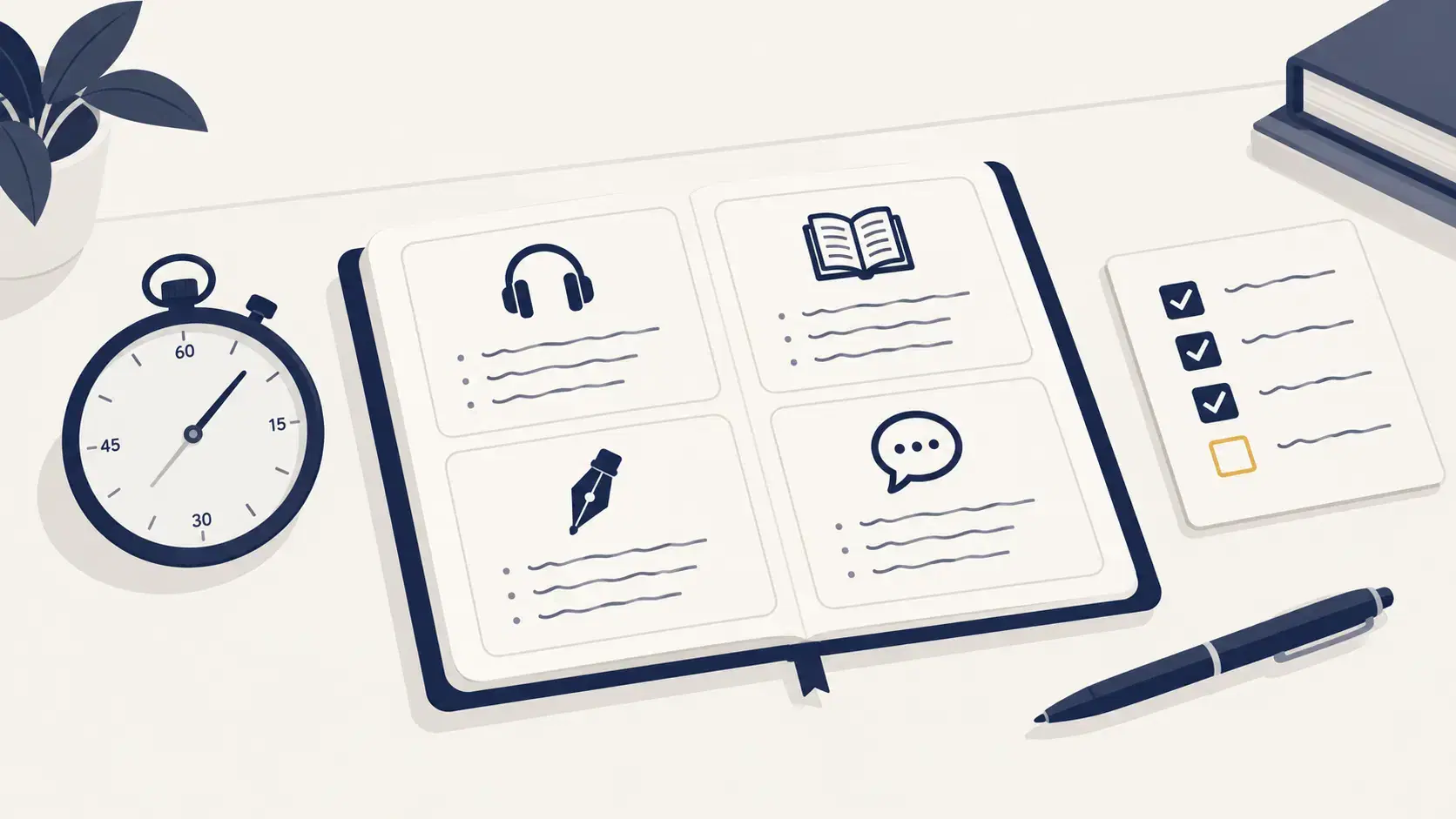
Zadway's IELTS practice covers all four skills, including timed Writing with AI examiner feedback, so you can run the baseline test this guide recommends and see where you really stand.
IELTS for beginners: what you need to know before you book
You may already know why you need IELTS. What you probably don't know yet is what actually happens on the day: which sections come first, how long each one lasts, whether you will sit the test on paper or on a computer, how much preparation you need, and whether you should book a date now or wait.
This guide answers those questions in one place, in the order a beginner tends to ask them. It reflects the official IELTS information available in October 2026. Fees, dates and policies differ by country and change over time, so treat the details here as a map and confirm specifics with your test centre when you book.
Quick answers
| Your question | Short answer |
|---|---|
| What is the test? | A four-part English test: Listening, Reading, Writing and Speaking. Each skill is scored from 0 to 9, plus an overall band score. |
| How long is it? | About 2 hours 45 minutes for the three written-format sections, plus an 11 to 14 minute Speaking interview. |
| Paper or computer in 2026? | Computer in most places. Paper-based testing was phased out from mid-2026. Speaking remains a face-to-face interview with a real examiner. |
| Is there a break? | Listening, Reading and Writing run back to back with no scheduled break. |
| How soon are results? | Computer-delivered results usually arrive within a few days, often in about two. |
| Am I ready today? | If you are new to IELTS, probably not yet. Take a full timed practice test first. |
| How long should I prepare? | 2 to 4 weeks to learn the format if your English is already at target level. 8 to 12 weeks to gain roughly one band. 3 to 6 months for a larger jump. |
| Should I rush to book? | Not usually. Book when timed practice scores are close to your target, or when a hard deadline forces your hand. |
What is the IELTS test?
IELTS, the International English Language Testing System, measures how well you can listen, read, write and speak in English. It is jointly owned by the British Council, IDP: IELTS Australia and Cambridge University Press & Assessment, and it is accepted by universities, employers and immigration authorities around the world.
Three facts are worth knowing from the start:
- Four skills, four scores. You receive a separate band score for each skill, plus an overall score.
- Same test, different booking routes. Whether you book through IDP or the British Council, you sit the same test and the score carries the same weight.
- Scores expire. Most institutions treat IELTS results as valid for two years from the test date, so plan your test around your application deadline.
IELTS Academic or General Training: which one do you need?
There are two versions of the test. Listening and Speaking are identical. Reading and Writing differ.
| IELTS Academic | IELTS General Training | |
|---|---|---|
| Typically used for | University and postgraduate study, some professional registration | Migration, work experience, training below degree level |
| Reading | Passages from journals, books and magazines | Everyday notices, workplace documents and longer general texts |
| Writing Task 1 | Describe a chart, graph, table or diagram | Write a letter (formal, semi-formal or informal) |
| Writing Task 2 | Essay | Essay |
The rule of thumb: the organisation reading your score decides which version you need, not you. If you are applying to a university, you almost always need Academic. If you are applying for migration, you may need General Training. Check the exact requirement published by your university, visa authority or professional body before you book, because booking the wrong version means paying for a second test.
IELTS test format and timing in 2026
The Listening, Reading and Writing sections add up to about 2 hours 45 minutes of testing when you include a short review period. Speaking is a separate short interview.
| Section | Time | Questions or tasks | What you do |
|---|---|---|---|
| Listening | About 30 minutes (plus a short review period on computer) | 40 questions, 4 recordings | Listen to each recording once and answer questions as you go |
| Reading | 60 minutes | 40 questions, 3 sections | Read texts and answer questions, managing your own time |
| Writing | 60 minutes | 2 tasks | Task 1: at least 150 words (suggested 20 minutes). Task 2: at least 250 words (suggested 40 minutes) |
| Speaking | 11 to 14 minutes | 3 parts | A face-to-face interview with an examiner |
Listening (about 30 minutes)
You hear four recordings, from an everyday conversation to an academic lecture, and answer 40 questions. Question types include multiple choice, matching, labelling a plan, map or diagram, and form, note and sentence completion.
Each recording is played only once, so concentration matters as much as vocabulary. On the computer-delivered test you get a 2-minute review at the end, not the 10-minute paper transfer time that older preparation books mention. For a method that works question type by question type, see our guide to scoring high in IELTS Listening.
Reading (60 minutes)
There are three sections and 40 questions in total, and the texts generally become more demanding as you progress. There is no extra time to copy answers across, so pacing is part of the skill.
The classic beginner mistake is spending too long on the first passage. A sensible starting target is about 20 minutes per section, which you then adjust with practice. Our guide to IELTS Reading skimming, scanning and time management shows how to do it.
Writing (60 minutes)
You complete two tasks, and Task 2 carries more weight than Task 1, so it deserves the larger share of your time. Academic Task 1 asks you to describe visual data, while General Training Task 1 asks for a letter. Task 2 is an essay in both versions.
Falling short of the minimum word count can cost you marks, because a short response is unlikely to cover the task fully. On a computer, the on-screen word counter helps you keep track. If you are starting from zero, begin with our step-by-step guide to writing an IELTS Task 2 essay.
Speaking (11 to 14 minutes)
Speaking is always a face-to-face conversation with a certified examiner, even when everything else is on a computer. It has three parts:
- Introduction and interview: short questions about familiar topics such as home, work, study and hobbies.
- Long turn: you receive a topic card and one minute to prepare, then speak on it for up to two minutes.
- Discussion: deeper follow-up questions linked to the Part 2 topic.
Your Speaking test is usually scheduled on the same day as the other sections, before or after them, though some centres schedule it within a few days either side. You are told the time when you book or shortly beforehand.
Is IELTS on paper or on computer in 2026?
For most candidates, the answer is now computer. The IELTS test owners announced that paper-based testing would be phased out from mid-2026, with exact timing varying by country. If you are booking now, assume you will sit IELTS on a computer unless your test centre tells you otherwise.
- "Writing on Paper" exists in some places. This hybrid option lets you take Listening and Reading on a computer but handwrite your Writing. It is not available everywhere, so ask your centre what it offers when you book.
- Speaking has not changed. It is still a face-to-face interview with an examiner.
- Nothing about the skills tested has changed. The content, question types, timing and scoring are the same as before.
Is computer IELTS different from paper IELTS?
The test content is the same. What changes is the experience.
| Computer-delivered | Older paper-based test | |
|---|---|---|
| Listening, Reading, Writing | Typed and clicked on a computer | Written on paper |
| Listening answer review | About 2 minutes at the end | 10 minutes to transfer answers |
| Results | Usually within a few days | Up to 13 days |
| Test dates | More frequent sessions | More limited dates |
| One Skill Retake | Available at eligible centres | Not available |
How to prepare for the computer test
- Practise on screen. Use official computer-delivered practice tests so the interface feels familiar before test day.
- Practise typing. If you type slowly, 250 words in about 40 minutes will feel tight. Build typing speed alongside your English.
- Learn the tools. The computer test offers features such as highlighting and note-taking. Get comfortable with them in advance, not during the exam.
How IELTS is scored
Each of the four skills is scored on a 0 to 9 band scale, and half bands such as 6.5 are possible. Your overall band score is the average of the four skills, rounded to the nearest half or whole band.
Bands line up roughly with the international CEFR framework:
| IELTS band | Approximate CEFR level | What it generally means |
|---|---|---|
| 4.0 to 5.0 | B1 | Can handle familiar topics, with clear limits |
| 5.5 to 6.5 | B2 | Competent, copes with most situations despite some errors |
| 7.0 to 8.0 | C1 | Good command, effective in complex situations |
| 8.5 to 9.0 | C2 | Very high, close to a native-like command |
Universities typically ask for an overall score plus a minimum in each skill, for example 6.5 overall with no skill below 6.0. Requirements vary a great deal by institution and course, so look up your own rather than relying on an average.
What examiners actually score in Writing and Speaking
Listening and Reading are marked against an answer key. Writing and Speaking are judged by trained examiners against four published criteria each, and this is where beginners most often misjudge their own level.
- Writing: Task Achievement (Task 1) or Task Response (Task 2), Coherence and Cohesion, Lexical Resource, and Grammatical Range and Accuracy.
- Speaking: Fluency and Coherence, Lexical Resource, Grammatical Range and Accuracy, and Pronunciation.
Each criterion carries equal weight. That is why a few impressive words rarely rescue an answer that is off-topic, disorganised or full of basic errors. To see how Writing marks are built up in detail, read how IELTS Writing Task 2 is scored, and for the speaking criteria see how to score high in IELTS Speaking.
What does IELTS cost, and when do you get your results?
Cost. The test fee depends on the country and the test centre, and it can change, so there is no single global price. Check the current fee with your local IDP or British Council office before you plan your budget. Versions of the test required for UK visa purposes (UKVI) usually cost more than the standard version.
Results. Computer-delivered results usually arrive within a few days, often in around two, and occasionally take up to five. That is much faster than the older paper test, so you no longer need to book months ahead just to leave time for results.
Changes and refunds. Policies differ by country. In some places a booking allows one free change, and refunds fall in steps depending on how far ahead you cancel, with no refund close to the test date. Read the terms for your own country at the point of booking. IELTS Australia's guide to cancellations, refunds and transfers is a useful example of how these rules are usually laid out.
IELTS One Skill Retake
If you sit IELTS on a computer and one skill falls short of your target, you may be able to retake just that skill instead of the whole test.
- You must have taken the full test on computer originally.
- You must retake within 60 days of the original test.
- Your test centre must offer it, and you can retake one skill per original test.
- Not every university or visa authority accepts One Skill Retake results, so check with yours first.
Am I ready to take IELTS today?
If you are new to IELTS, the honest answer is probably not today, and that is completely normal. Being ready is not only about your English level. It is your English level, plus knowing the format, plus managing time under pressure.
A five-step readiness check
- Set your target. Find the exact overall score and minimum per-skill scores your university or visa requires.
- Take one full, timed, official practice test. Do all four skills in test conditions: no pausing, no dictionary, no replaying the audio. Do not skip Writing and Speaking.
- Score it honestly. Listening and Reading can be self-marked against the answer key. For Writing and Speaking, get feedback from a teacher, an experienced tutor or a reliable scoring tool, because these are the two skills where beginners tend to overestimate themselves.
- Compare the result with your target. Use the table below.
- Repeat in two to three weeks. One result can be a fluke. A consistent pattern across two or three tests is what tells you that you are ready.
What your practice result means
| Practice result against your target | What it likely means | What to do |
|---|---|---|
| Within about 0.5 band of target in every skill, on at least two tests | You may be ready or close | Book a date and keep working on your weakest skill |
| About 1 band below target | A realistic goal within a couple of months | Study for 8 to 12 weeks, retest, then book |
| 1.5 bands or more below target | You need to build your English, not just exam technique | Plan 3 to 6 months and start with general English |
| Strong Reading and Listening, weak Writing or Speaking | A very common pattern | Prioritise practice that comes with feedback |
| You ran out of time in Reading or Writing | A pacing problem, not only an English problem | Practise with strict timers |
Signs you are probably not ready yet
- You have never done a full IELTS practice test under timed conditions.
- You are not sure how Writing Task 1 and Task 2 differ.
- You regularly finish Reading with unanswered questions.
- You have never recorded yourself answering a Speaking Part 2 question.
- You plan to "just see what happens" in order to learn the test. That is an expensive way to practise.
How long does it take to prepare for IELTS?
It depends on the gap between your current level and your target, and on how many hours a week you can realistically study. These are rules of thumb from teaching experience, not guarantees.
| Situation | Typical time |
|---|---|
| Already at your target level, and only need to learn the format | 2 to 4 weeks |
| Need to improve by about one band (for example 6.0 to 7.0) | 8 to 12 weeks at roughly 5 to 8 hours a week |
| Need to move up a full CEFR level (for example B1 to B2) | 3 to 6 months |
| Large gap, or a high target such as 7.5 or above | 3 months or more, usually with expert feedback |
The people who improve fastest tend to do three things. They study consistently, because a little most days beats a weekend binge. They get feedback on Writing and Speaking. And they review their mistakes instead of simply doing more tests.
A simple eight-week starting plan
| Week | Focus |
|---|---|
| 1 | Learn the format. Take a full timed practice test as your baseline and identify your weakest skill. |
| 2 to 3 | Build fundamentals: Reading skimming and scanning, Listening question types, Writing structure for Task 1 and Task 2, Speaking Part 1 basics. |
| 4 to 5 | Timed skill drills. Start writing full essays and getting them reviewed. Record and review your Speaking answers. |
| 6 | Take a second full timed test, compare it with your baseline and adjust the plan. |
| 7 | Fix recurring errors. Practise on a computer if you will sit the computer-delivered test. |
| 8 | Take a final full test, revise lightly and rest. Do not cram the night before. |
Where and how to prepare
You do not need to spend a lot of money to start. A solid toolkit has four parts.
1. Official materials. The IELTS owners publish free sample questions, practice tests and tips, and a test booking often includes access to practice materials. Computer-delivered tests also have a free familiarisation test, so try it before test day.
2. Official practice books. Cambridge University Press & Assessment publishes past-style IELTS practice tests. They are the closest thing to the real exam, so save a few for your final timed practice.
3. Feedback on Writing and Speaking. These are the hardest skills to improve alone, because you cannot reliably judge your own essay or pronunciation. Use a qualified teacher, a study partner who knows the band descriptors, or a scoring tool that explains why you received a band and not only the number.
4. Daily English exposure. Listen to podcasts, news and lectures, read articles on science, society and technology, and write a few sentences every day. IELTS tests real English, so real English practice matters. If vocabulary is your gap, start with how to learn IELTS vocabulary properly.
Mistakes beginners make
- Practising only the skill they enjoy, usually Listening or Reading, and avoiding Writing.
- Not timing themselves.
- Memorising "perfect answers" for Speaking. Examiners are trained to spot rehearsed responses, and they can lower your score.
- Using complicated vocabulary they are not sure of instead of clear, accurate English.
- Booking the test first and then discovering the format for the first time.
Should I rush to book an IELTS test?
Usually no, but there are good reasons to book sooner if you have a deadline.
Reasons not to rush
- The test is a real cost, and sitting it unprepared to "see how it goes" is expensive practice.
- Faster computer results mean you can book closer to your deadline than candidates could in the past.
- If you are not within about 0.5 band of your target on timed practice tests, a booked date mainly adds stress.
Reasons to book earlier
- You have a hard deadline, such as a university offer condition, a visa application or a job requirement.
- Popular dates can fill up, especially close to application seasons.
- A date in the calendar is a strong motivator.
- Many centres allow a free change or a partial refund if you act early enough, but confirm the current terms for your country.
A sensible booking approach
- Work out your latest possible test date from your deadline, leaving time for a possible retake. Remember that One Skill Retake must happen within 60 days of the original test.
- Take a baseline practice test this week.
- If you are within reach of your target in about 8 to 12 weeks of study, book a date that far out and use it as a personal deadline.
- If you are further away, delay booking and plan 3 to 6 months of study.
IELTS test day: what to expect
- Bring valid ID. It must match the name on your booking. Check your centre's confirmation for exactly what it accepts.
- Arrive early. Check-in includes identity verification, and latecomers can be refused entry.
- Plan for no break. Listening, Reading and Writing run back to back, so eat beforehand and use the bathroom before you start.
- Check your Speaking time. The centre schedules it, usually on the same day, and tells you when.
- Read the on-screen instructions and keep an eye on the timer shown on the screen.
- Stay calm if one section goes badly. Each skill is scored separately, so a hard Reading section does not ruin your Speaking score.
Frequently asked questions about IELTS for beginners
Is IELTS paper-based or computer-based in 2026?
IELTS is now delivered on computer in most places, because paper-based testing was phased out from mid-2026. A "Writing on Paper" option exists in some countries, so check what your centre offers. Speaking is always face to face with an examiner.
How long is the IELTS test?
About 2 hours 45 minutes for Listening, Reading and Writing combined, with Listening taking about 30 minutes and Reading and Writing 60 minutes each. The Speaking test is a separate interview of 11 to 14 minutes.
How many sections are there in IELTS?
Four: Listening, Reading, Writing and Speaking. Each is scored from 0 to 9, and you also receive an overall band score.
Is computer-delivered IELTS easier than paper?
No. The content, difficulty, timing and scoring are the same. Some candidates find typing and on-screen tools easier, and others find them harder, so practise in the format you will actually sit.
How long does it take to get IELTS results?
Computer-delivered results usually arrive within a few days, often in about two, and sometimes take up to five. Paper-based results used to take up to 13 days.
How much does IELTS cost?
The fee depends on your country and test centre, and it changes over time. Check the current price with your local IDP or British Council office before you book. UKVI versions usually cost more.
How long should I prepare for IELTS?
It depends on your starting level and your target. Learning the format alone can take 2 to 4 weeks, improving by about one band usually takes 8 to 12 weeks of regular study, and moving up a full CEFR level often takes 3 to 6 months.
Can I retake just one section of IELTS?
In many places, yes. IELTS One Skill Retake lets you retake one skill within 60 days of a full computer-delivered test, at centres that offer it. Check that your university or visa authority accepts it.
How long is an IELTS score valid?
Most institutions accept IELTS results for two years from the test date, though the receiving organisation sets its own rule.
Which IELTS should I take, Academic or General Training?
Take Academic for university study and most professional registration. Take General Training for most migration purposes and for work or training below degree level. Always confirm with the organisation that will read your score.
Your next steps
- Confirm which IELTS version and what score your university, visa authority or employer requires.
- Take a full timed practice test this week to find your baseline.
- Choose a preparation plan that matches your gap: 2 to 4 weeks, 8 to 12 weeks, or 3 to 6 months.
- Get feedback on Writing and Speaking early, because they are the hardest skills to fix alone.
- Book your test once your timed results are close to your target, or once you have a hard deadline to work back from.
Start your IELTS preparation with Zadway
Knowing the format is only the first step. Zadway gives you timed practice across Writing, Reading, Listening, Speaking and vocabulary, with examiner-style feedback that explains why you earned each band. See how Zadway works, compare pricing, or create your student account and take your baseline this week.
Official sources and further reading
Fees, policies and availability change, so always confirm on official pages when you book.
Last updated: 25 October 2026. This article is general guidance, not an official IELTS publication. Requirements vary by institution and country, so check with your university, visa authority or professional body before booking.
See Also
IELTS Reading Techniques: Skimming, Scanning & Timing
Master examiner-approved skimming, scanning and time-management techniques to answer all 40 IELTS Reading questions accurately within the 60-minute limit.
How to Write an IELTS Writing Task 2 Essay: Step-by-Step
A step-by-step method for planning, structuring and writing a strong IELTS Writing Task 2 essay, from an experienced IELTS examiner and prep teacher.
How to Start IELTS Writing Task 2 and Reach Band 7+
Stuck on a blank page, or plateaued at Band 6.5? See how Zadway's 200+ step-by-step Writing Tutorials and AI essay scoring help you reach IELTS Writing Band 7+.
How to Score High in the IELTS Listening Test
An examiner's guide to IELTS Listening: preview questions before the audio plays, predict answer types, avoid distractor traps, and fix spelling errors.
How to Score High in the IELTS Speaking Test
Learn what IELTS examiners actually score in the Speaking test, with a step-by-step method for fluency, vocabulary, grammar and pronunciation.
Got Band 6? Don't Just Rebook the IELTS Test
Scored Band 6 but need Band 7? Don't just rebook the IELTS test. Learn why retaking alone rarely works, and what to fix first, examiner-style.