
How to Start IELTS Writing Task 2 and Reach Band 7+
This case study looks at the Writing module in Zadway: the 200+ step-by-step Writing Tutorials, the AI essay scoring and the Band 7 and Band 8 rewrites that work together to get you started and keep you improving.
The blank page is not a writing problem
You have read the question three times. The clock is running. You know some English, you have opinions, and yet the page is still empty.
Almost every IELTS candidate has been here, and it is rarely a sign that your English is not good enough. It is a sign that nobody has shown you a repeatable way to begin. Without one, you are trying to invent ideas, choose a structure and produce accurate sentences all at the same moment, and that is exactly when most people freeze.
This page is for two kinds of candidate. The first cannot get started. The second writes plenty but has been stuck at Band 6 or 6.5 and cannot see what would lift the score to Band 7 or above. Zadway's Writing module is built for both, and the rest of this page shows you exactly how.
Which of these sounds like you?
The scenarios on this page are illustrative composites, built from patterns examiners and teachers see again and again. They are not real candidates, and no results are quoted.
| If this sounds like you | What is usually going on | What Zadway Writing gives you |
|---|---|---|
| "I read the question and my mind goes blank." | There is no planning routine, so ideas, structure and language all have to be invented at once. | A step-by-step tutorial for your exact prompt: understand, plan, map keywords, structure, then write. |
| "I write a lot, but I am stuck at Band 6.5." | One or two criteria sit just below Band 7, often because ideas are under-developed or word choice is imprecise. | A band score for each criterion, sentence-level corrections, and Band 7 and Band 8 rewrites of your own essay. |
| "I never know whether my practice essays are any good." | Without examiner-style feedback, nothing tells you what to change next. | Scoring against the official criteria every time you submit, so you always know your next step. |
What the examiner sees when you freeze
As an examiner, the pattern is easy to spot. A candidate who has not planned tends to produce one of three things:
- an introduction that copies the question, followed by a body that drifts away from it;
- a first paragraph with three half-explained ideas instead of one idea developed properly;
- a conclusion that arrives because time has run out, not because the argument is finished.
Every Task 2 script is marked on four criteria: Task Response, Coherence and Cohesion, Lexical Resource and Grammatical Range and Accuracy. Your planning notes are never marked, but they decide how well you do on the first two, and a well-planned essay also leaves you more attention for vocabulary and grammar. If you would like the full picture first, read our guide to how IELTS Writing Task 2 is scored.
Zadway Writing in one minute
The Writing module has two halves that feed each other:
- Learn the method. More than 200 Task 2 topics each come with their own Step-by-Step Tutorial: eight guided steps, hints at every step, a worked model essay and a self-check list.
- Test it on a real essay. Submit what you write and get an AI examiner-style report: a band score for each criterion, sentence-level corrections, and the same essay rewritten at Band 7 and Band 8.
Because the tutorial is matched to the exact prompt you choose, you never have to wonder how a general method applies to your question. You learn it, use it, get marked and go again.
Step 1: Choose a prompt from 200+ topics
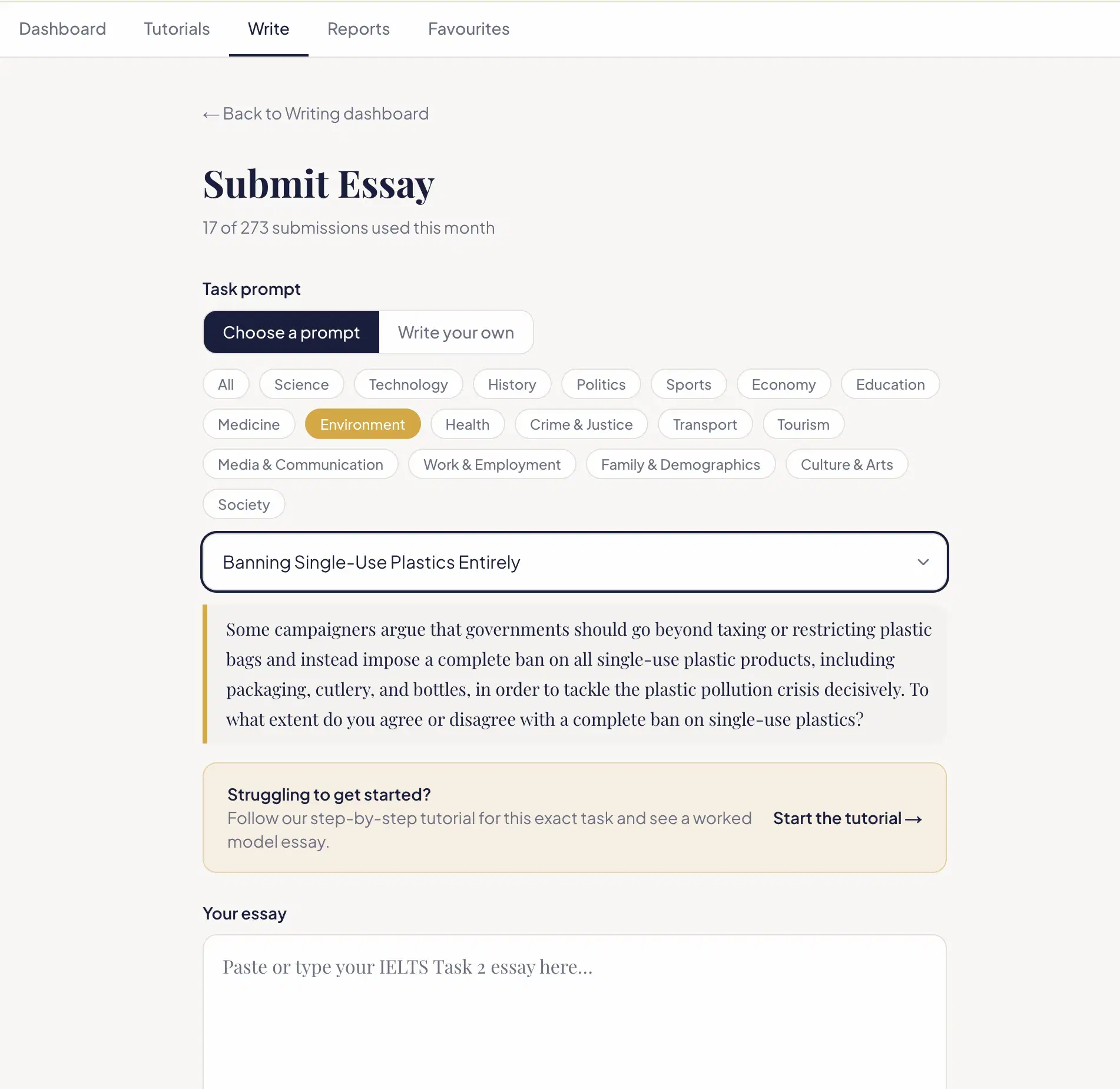
Open Submit Essay and you will see the prompt library. Filter by topic area, from Science, Technology and Education to Crime & Justice, Health, Work & Employment, Media & Communication and Society, then pick a prompt from the list. Prefer to answer a question from your teacher or a past paper? Switch to Write your own and paste it in.
This matters more than it sounds. Choosing topics you find difficult on purpose, rather than always writing about the ones you like, is one of the quickest ways to widen the range of ideas and vocabulary you can call on in the exam.
The "Struggling to get started?" box
Look just beneath the prompt you have chosen. For prompts that have a tutorial, you will see a highlighted box that asks:
Struggling to get started? Follow our step-by-step tutorial for this exact task and see a worked model essay.
That one box is the bridge between not knowing where to begin and a clear plan. One click on Start the tutorial and you are inside a guided walkthrough built for the question on your screen, with no searching for the right lesson and no generic advice to translate.

Inside the eight-step tutorial
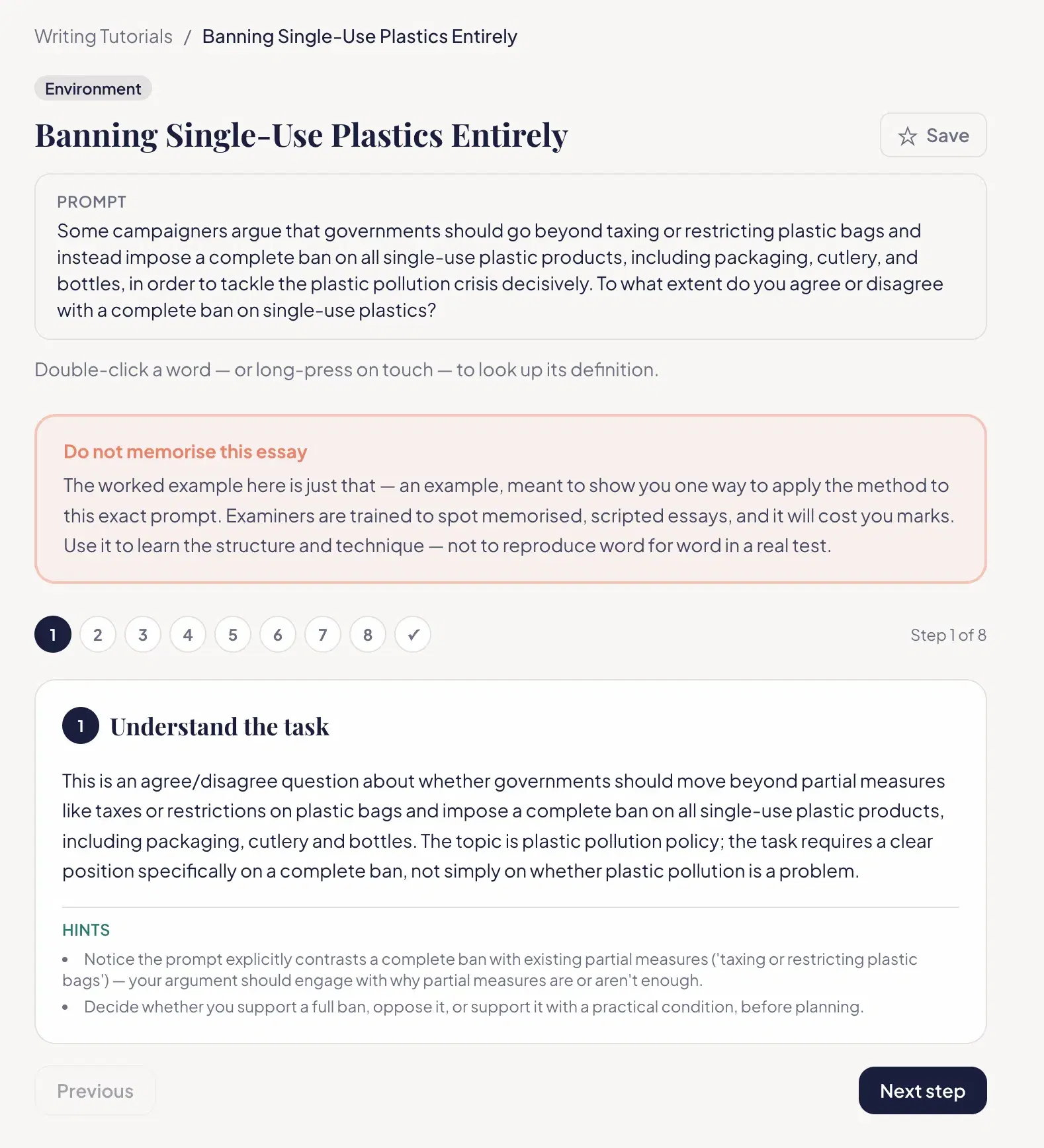
Each tutorial shows a row of numbered steps along the top, so you always know where you are (Step 1 of 8) and can jump back to any earlier step. Each step has a short explanation written for your specific prompt, plus hints that point at the traps candidates usually fall into.
The eight steps follow the order a strong candidate works in: understand the task, plan, build a keyword map, decide the structure, write the introduction, develop each body paragraph, connect your ideas, and close the argument. For the same method written out in full, with a worked example, see our guide to writing an IELTS Task 2 essay step by step.
Step 1: Understand the task
Most low scores in Task Response begin here. The tutorial separates the topic from the task. For a prompt about volunteer tourism, for example, it makes clear that you are being asked to discuss two specific views and give your own opinion, not to write generally about travel or volunteering. The hints then nudge you to decide early where you stand, which is what keeps an opinion essay focused from the first sentence to the last.
Step 2: Plan before you write
Instead of "brainstorm some ideas", the tutorial gives you a working method: list effects for each side, then keep asking why until you reach a real reason rather than a claim. You do not need ten arguments. One idea per body paragraph, developed properly, is a better foundation for Band 7 than a list of five undeveloped ones.
Step 3: Build a keyword map
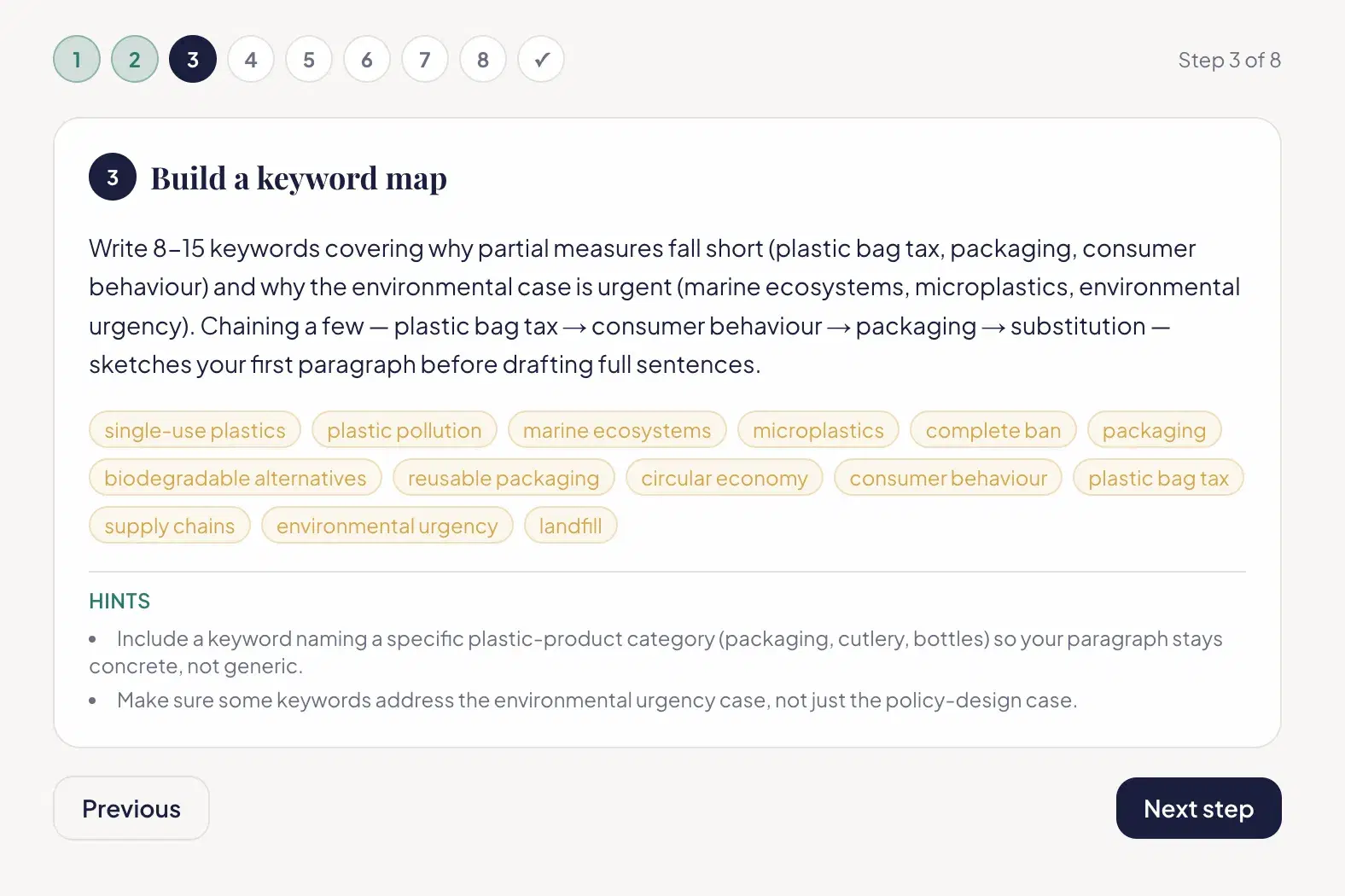
Here you gather a small set of topic-specific words and phrases for this debate before you draft. It is a quiet but powerful step: when the vocabulary is already in front of you, you stop reaching for "good", "bad" and "important", and your Lexical Resource starts to show up naturally.
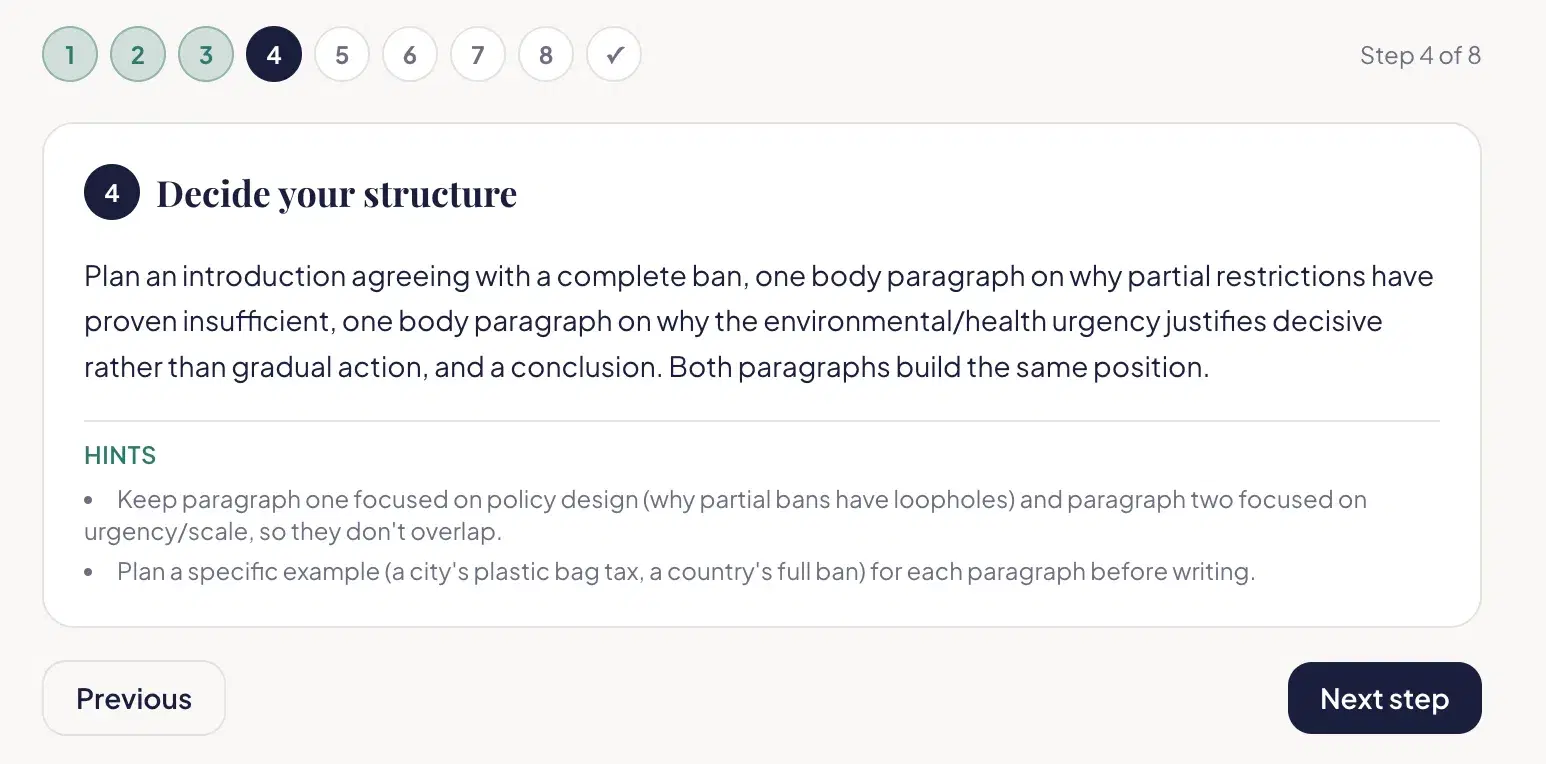
Step 4: Decide your structure
Now your ideas get a home. You decide what the introduction will do, which idea belongs in which paragraph, and how the conclusion will close the argument, before you write a full sentence. A clear plan is the quickest route to strong Coherence and Cohesion, because the logic is already settled by the time you start writing.
Steps 5 and 6: Write the introduction and develop each body paragraph
With a plan in hand, the writing itself becomes far less frightening. The tutorial shows you how to paraphrase the question without losing its meaning, how to state your position clearly, and how to build a body paragraph as a small argument: a clear point, an explanation of why it is true, and an example that makes it concrete.
Step 7: Connect ideas, not just sentences
Many candidates think cohesion means starting every sentence with "Moreover" or "However". Examiners see this all the time, and overusing linkers can hold a score down. This step teaches you to link ideas, so that each sentence grows naturally out of the one before it. If this is a weak spot for you, our article on linking word mistakes in IELTS Writing is a good companion.
Step 8: Write a conclusion that closes the argument
A conclusion should restate your position and pull the main points together, not introduce something new at the last minute. The final step shows you how to finish cleanly, so the reader leaves with a clear sense of where you stand.
The final tick: a worked model essay and a self-check list
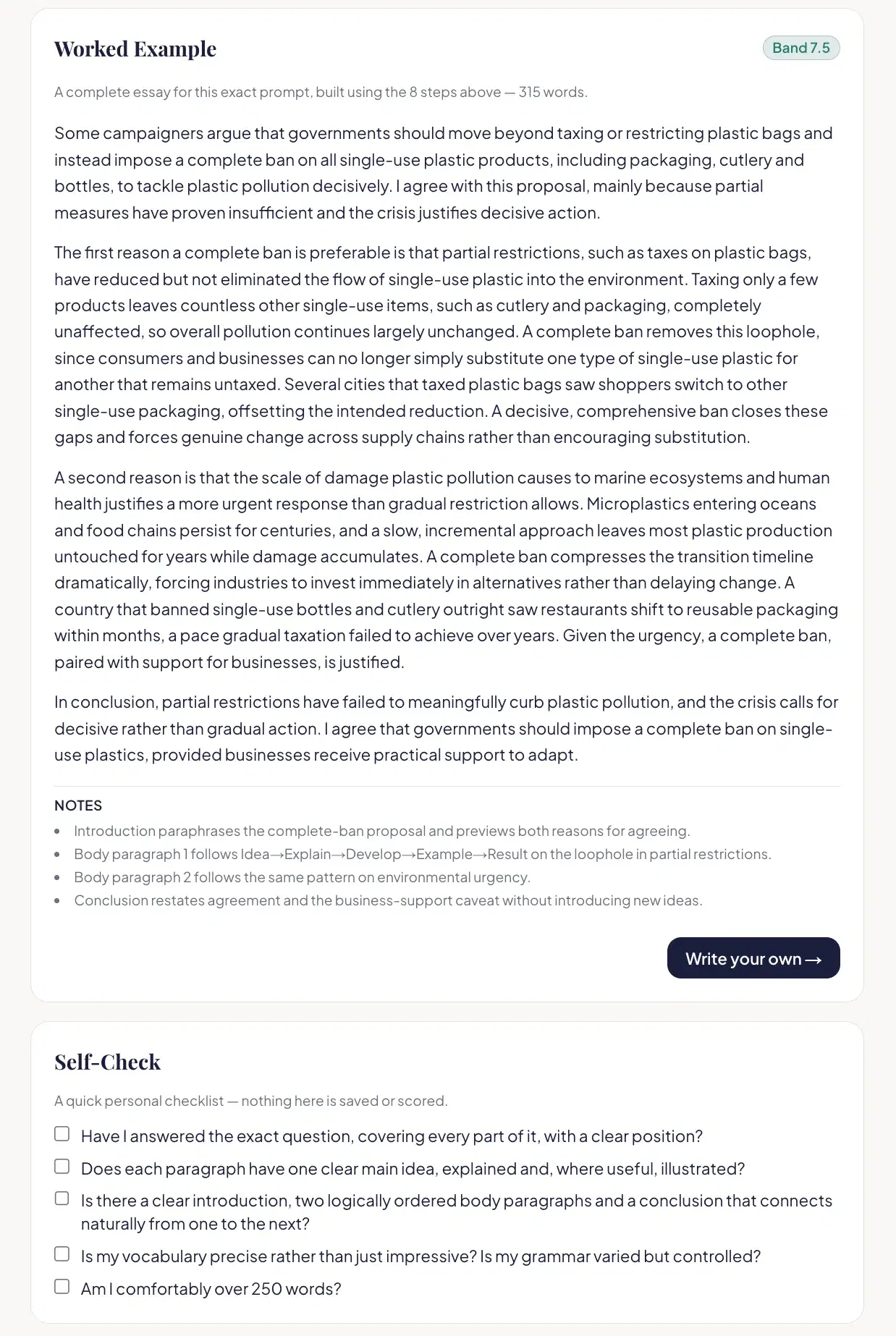
After step 8, the last circle in the navigator opens something candidates tend to value most: a worked model essay at Band 7.5 or 8.0 built from the same eight steps you have just followed, plus a short self-check list to mark your own attempt against before you submit it.
Seeing a finished essay after you have worked through the method is very different from reading a model answer cold. You can see how each decision, from the paragraph plan to the choice of vocabulary, turned into real sentences.
A method, not a script to memorise
Be careful how you use the model essay. Examiners are trained to recognise memorised or templated answers, and a memorised essay that does not answer the question in front of you will score badly on Task Response. The tutorials teach the method and show one worked example, but the essay you write must still be your own. That is why the next part matters.
Now write your own essay and get it scored
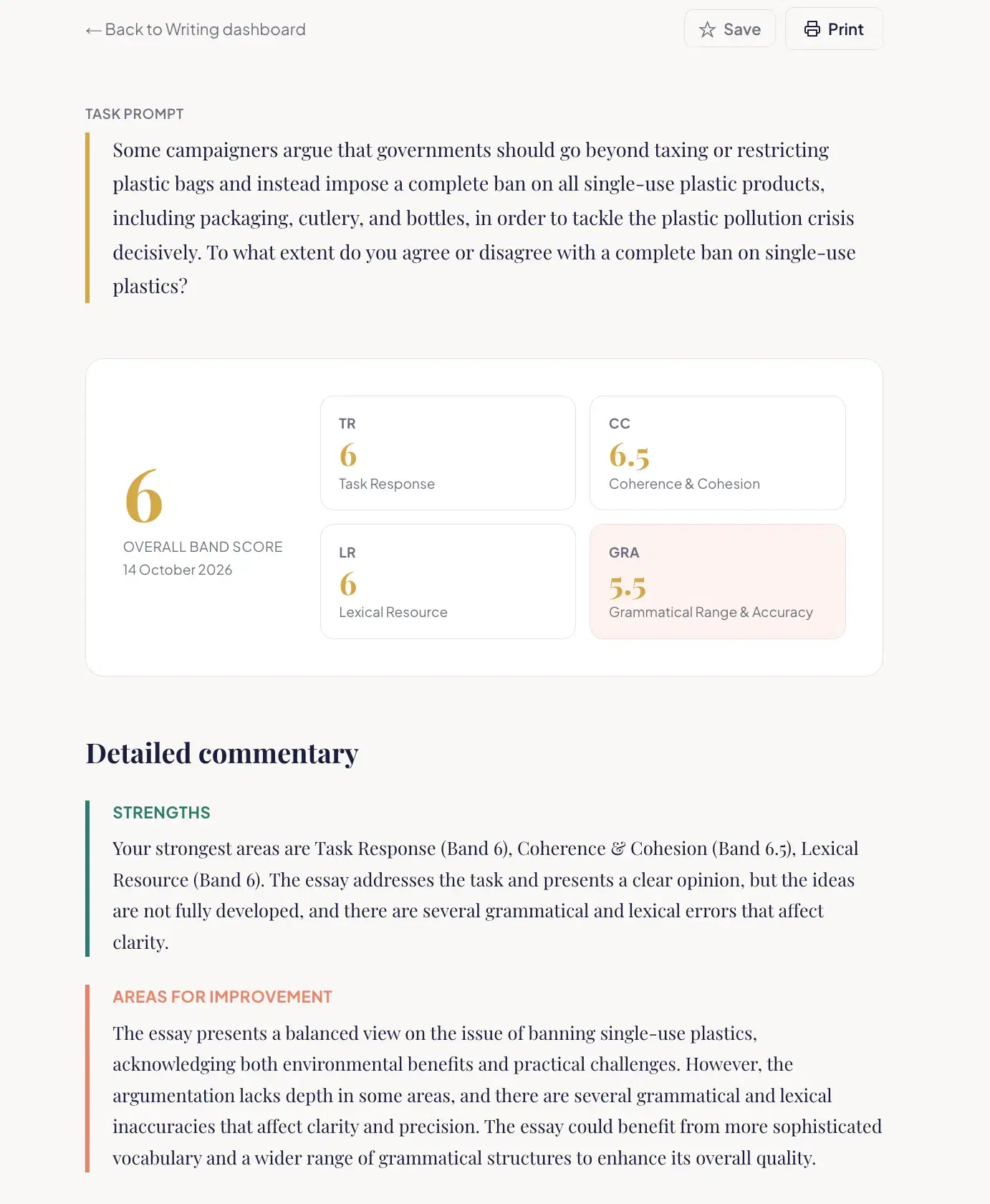
Once you have worked through a tutorial, write your essay in the box on the Submit Essay screen and submit it. Zadway's AI scoring system marks it the way an examiner would and returns a report with four parts.
A band score for every criterion
You receive an overall band and a separate score for each of the four official criteria. That is the information that matters if you are stuck at 6.5, because an overall band is an average. Knowing whether Task Response, Coherence and Cohesion, Lexical Resource or Grammatical Range and Accuracy is the one holding you back tells you exactly where to spend your next hour.
Sentence-level corrections
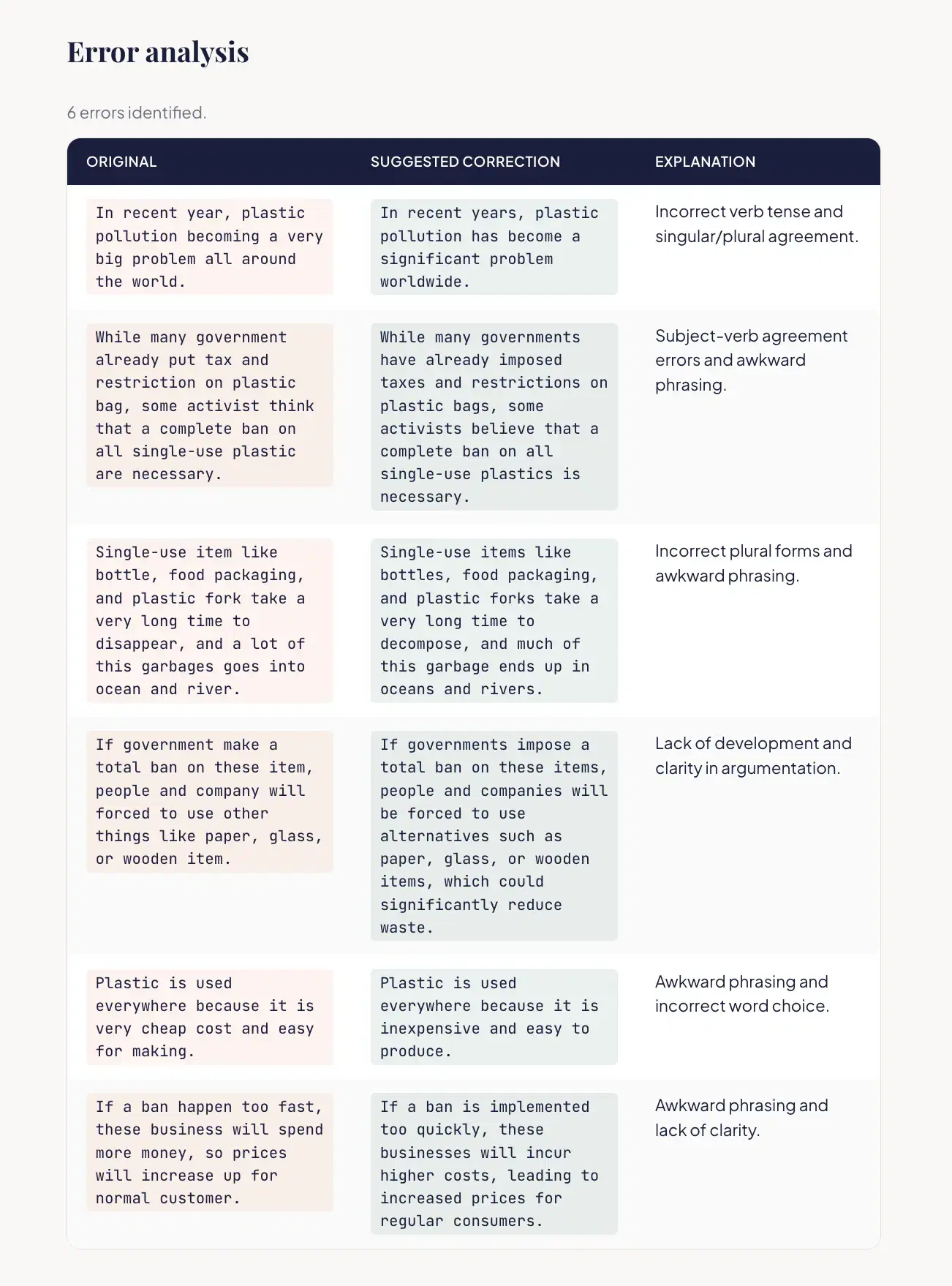
Beyond the numbers, the report goes through your essay sentence by sentence and shows which ones cost you marks, and why. For example:
Your sentence: Many young people today prefers to volunteer abroad, it can give them more experience.
Corrected: Many young people today prefer to volunteer abroad because it can give them valuable experience.
One correction fixes subject-verb agreement, a comma splice and a vague word in a single pass, and the explanation tells you which habit to watch for next time.
Your essay rewritten at Band 7 and Band 8
This is the feature that moves candidates past a plateau. Zadway rewrites your own essay at Band 7 and at Band 8, keeping your ideas, so the difference between where you are and where you want to be is concrete rather than a piece of vague advice. Here is the kind of difference you will see, on a single idea:
Original: Volunteering abroad is good because people can help others and learn.
Band 7: Volunteering abroad can benefit both sides: local communities receive practical help, while volunteers gain first-hand experience of another culture.
Band 8: When well organised, volunteering abroad creates a genuine exchange: host communities gain skills and labour they might otherwise lack, while volunteers gain an understanding that no classroom could supply.
These lines illustrate the kind of progression the rewrites show; they are not output from a real report. Notice that nothing here depends on rare vocabulary. The gain comes from precision and from developing the idea, which is exactly what you can learn to copy.
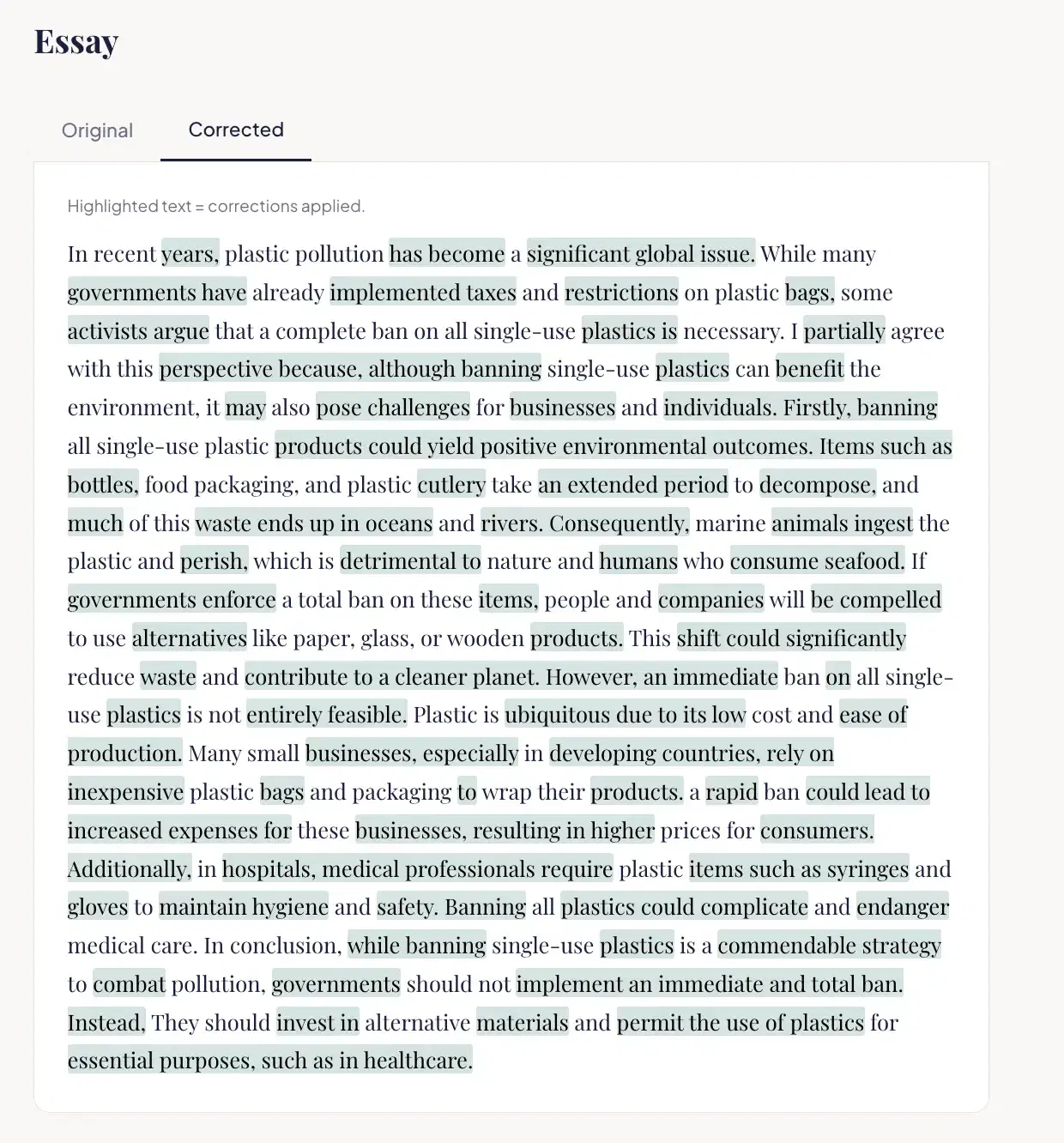
Consistent, examiner-style scoring
Zadway scores against the published IELTS band descriptors, and the same essay returns the same result every time. That consistency matters: when your score moves, it is because your writing improved, not because of luck on the day. Treat it as a reliable practice guide. Your official band can only come from an IELTS test, and no practice tool can promise a particular result.
If you are stuck at Band 6 or 6.5: finding the missing half-band
A Band 6.5 overall usually means one or two criteria are sitting just below the Band 7 standard. Here is what that often looks like, and where the Writing module helps.
| Criterion | A common 6.5 pattern | What Band 7 looks like | Where Zadway helps |
|---|---|---|---|
| Task Response | Ideas are listed but not fully explained; the position drifts. | A clear position throughout, with main ideas extended and supported. | Steps 1 and 2 of the tutorial; the self-check list. |
| Coherence and Cohesion | Mechanical linking words; paragraphs with more than one main idea. | Logical progression, with a clear central topic in each paragraph. | Steps 4 and 7; the per-criterion score. |
| Lexical Resource | Repeated basic words; occasional awkward choices. | Some less common vocabulary, used with awareness of collocation and style. | Step 3 keyword map; the Band 7 and Band 8 rewrites. |
| Grammatical Range and Accuracy | Simple sentences, or complex ones with frequent small errors. | A variety of complex structures with frequent error-free sentences. | Sentence-level corrections. |
The point is not to tick off every row at once. It is to find the one row that holds you back and fix that.
A simple loop to break through
- Pick a prompt from a topic you find hard.
- Work through its tutorial, then compare your plan with the worked model essay.
- Write your own essay within 40 minutes, aiming for at least 250 words.
- Submit it and read the per-criterion scores before anything else.
- Study the corrections and the Band 7 rewrite, then rewrite your weakest paragraph in your own words.
- Move on to a new prompt and repeat, keeping an eye on your lowest criterion.
Over several essays you can look back through your report history and see which criterion is rising, and which still needs work. That trend line is what turns "I think I am improving" into something you can check.
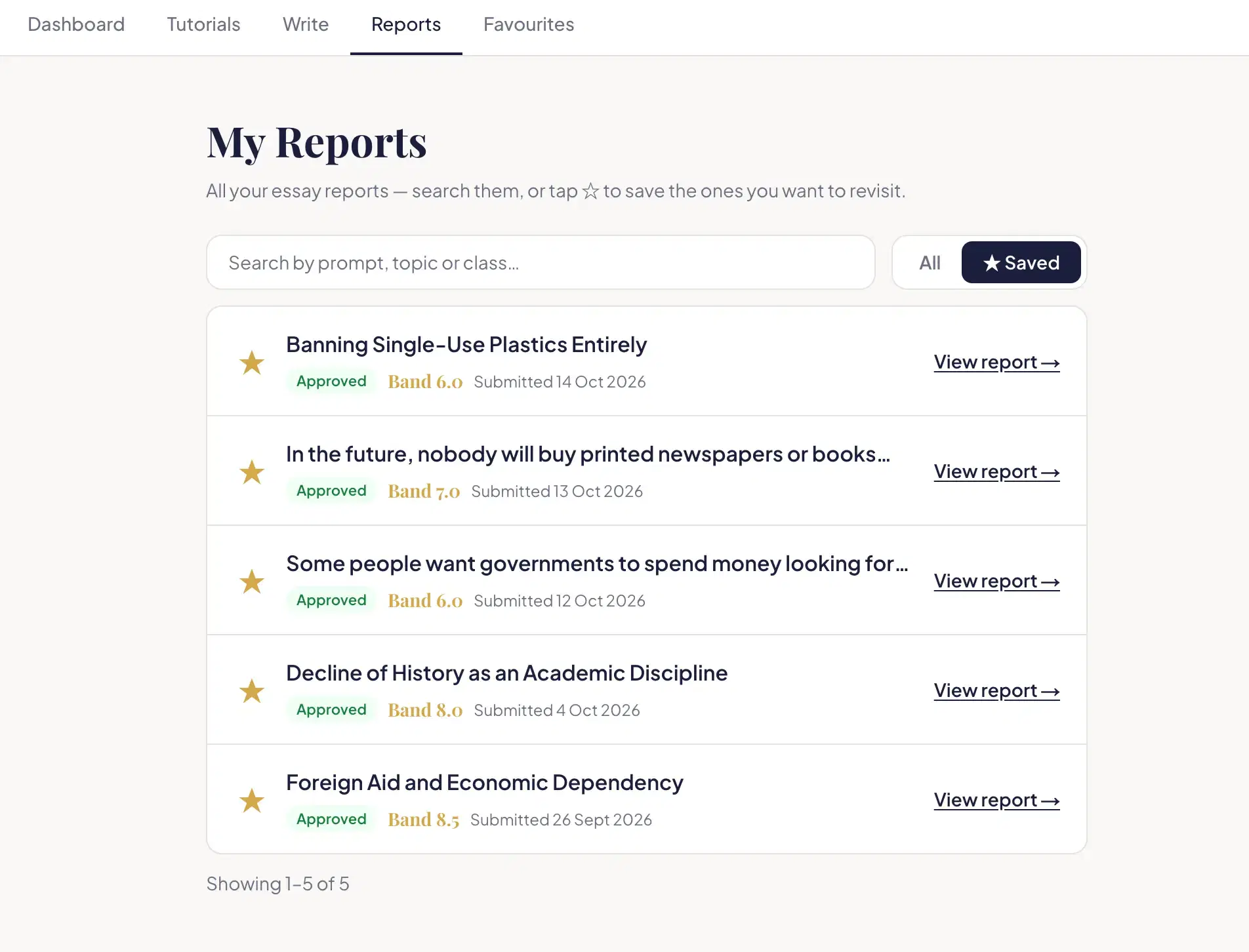
The rest of the platform backs your Writing up
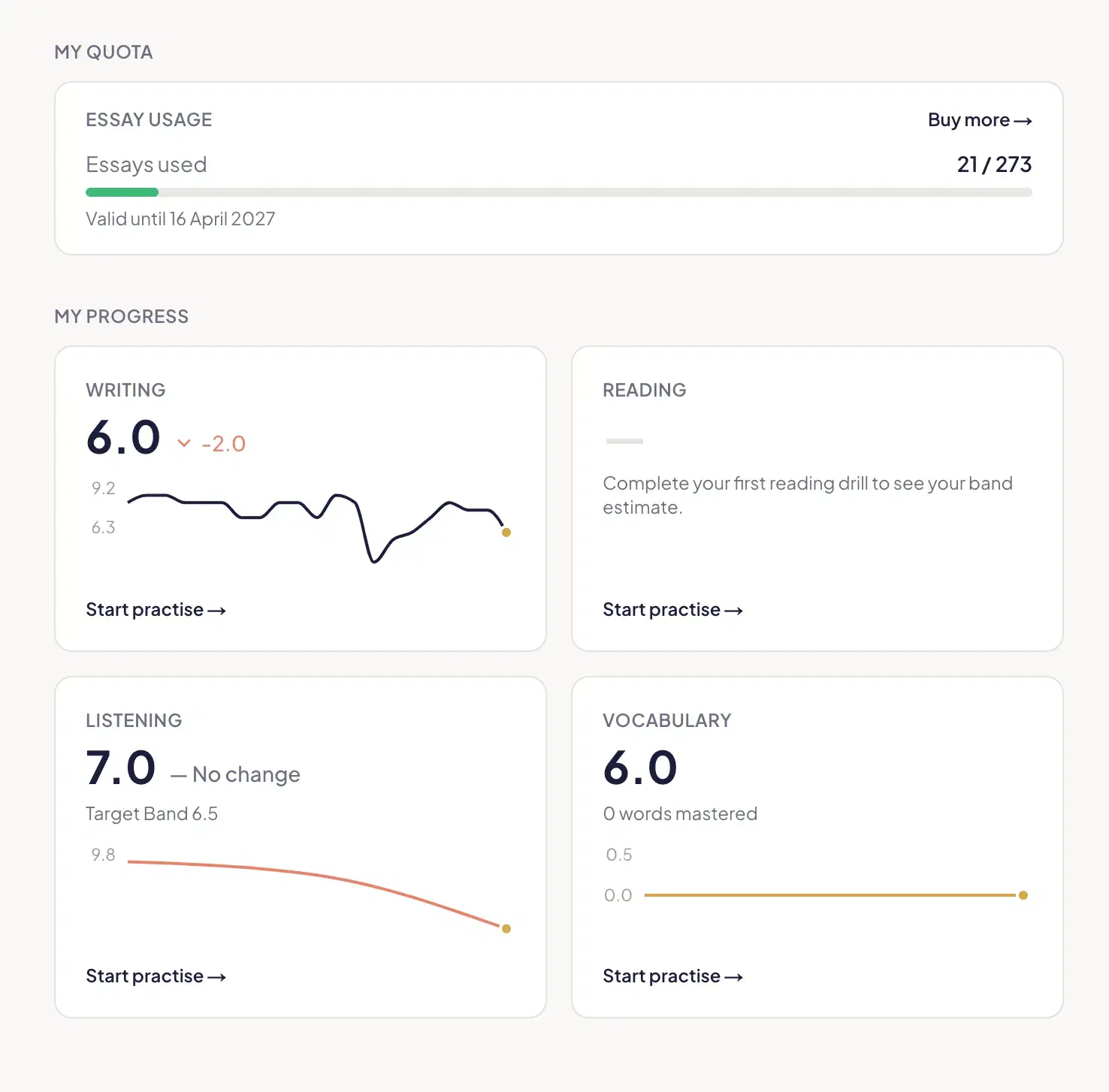
Writing scores depend on vocabulary and on how comfortably you handle English in general, so Zadway keeps the other skills within reach:
- Vocabulary Bank: build topic vocabulary with practice drills and flashcards, so the words from your keyword map are ones you can actually use. See why vocabulary accuracy matters so much for a high band.
- Reading practice: look up an unfamiliar word with a double-click and save it, so reading feeds your Writing vocabulary. Read the Reading vocabulary lookup case study.
- Listening practice: use transcript mode to study what you missed. See how to improve your IELTS Listening through practice.
- Speaking practice: drills for Parts 1, 2 and 3, so the ideas you learn to develop in writing also help you speak with more confidence.
One account, one place to practise all four skills, with feedback on every attempt.
What changes for these candidates
Return to our two illustrative candidates.
The candidate who could not start did not suddenly become a better writer overnight. What changed was that the first ten minutes stopped being a mystery. With a tutorial to follow, planning became a routine, and the routine removed the fear.
The candidate stuck at 6.5 did not need to write more essays. They needed to know which criterion was costing them marks, and to see what a better version of their own paragraph looked like. Once the report pointed at one weak criterion, practice became targeted instead of repetitive.
The lesson: a method, then feedback, then repetition
The strongest candidates are rarely the ones who write the most. They are the ones who plan every time, get honest feedback on what they wrote, and fix one specific thing before the next attempt. Zadway's Writing module puts those three things in one loop: a tutorial for the method, an AI report for the feedback, and 200+ prompts for the repetition.
What you get when you sign up
- Start for free. Create an account with no credit card required and see how your own essay is scored.
- Unlock the tutorials with a package. Step-by-Step Writing Tutorials are included in Zadway's study packages, which are one-time purchases with no subscription and no auto-renewal. Compare the options on the pricing page.
- See your own gap. The fastest way to know what stands between you and Band 7 is to submit an essay and read the report.
Frequently asked questions
How do I start an IELTS Writing Task 2 essay when I cannot think of ideas?
Spend the first few minutes on the question, not the page. Work out the topic and the task, then list one idea for each part of the question and ask why until you can explain it. Zadway's tutorials teach exactly this routine, step by step, for each prompt.
How many Writing Tutorials does Zadway have?
There are more than 200, each matched to a Task 2 prompt in the library and covering topics from Crime & Justice and Education to Technology, Health and Work & Employment. New ones are added over time.
Can I use my own essay question instead of choosing from the library?
Yes. Choose Write your own on the Submit Essay screen and paste in your question. You will get the same report: scores for each criterion, sentence-level corrections and Band 7 and Band 8 rewrites. Tutorials are written for the prompts in the library.
How long does it take to move from Band 6.5 to Band 7 in Writing?
It depends on your starting point, which criterion is holding you back and how consistently you practise, so no honest source can give you a fixed timeframe. What you can do is find your weakest criterion early and practise it deliberately. Targeted practice almost always beats simply writing more essays.
Are Zadway's band scores the same as my official IELTS result?
They are a practice estimate based on the published band descriptors, which makes them a reliable guide to your strengths and weaknesses. Only an official IELTS test can give you an official band, so treat the score as a way to decide what to practise next.
Start with one prompt
You do not need a perfect plan to begin. Pick one prompt you find difficult, open its tutorial, write your essay and see how it is scored. Start free on Zadway, or look at the Writing module, see how Zadway works and compare plans when you are ready for the full set of tutorials. Your Band 7 starts with a first sentence, and now you have a way to write it.
See Also
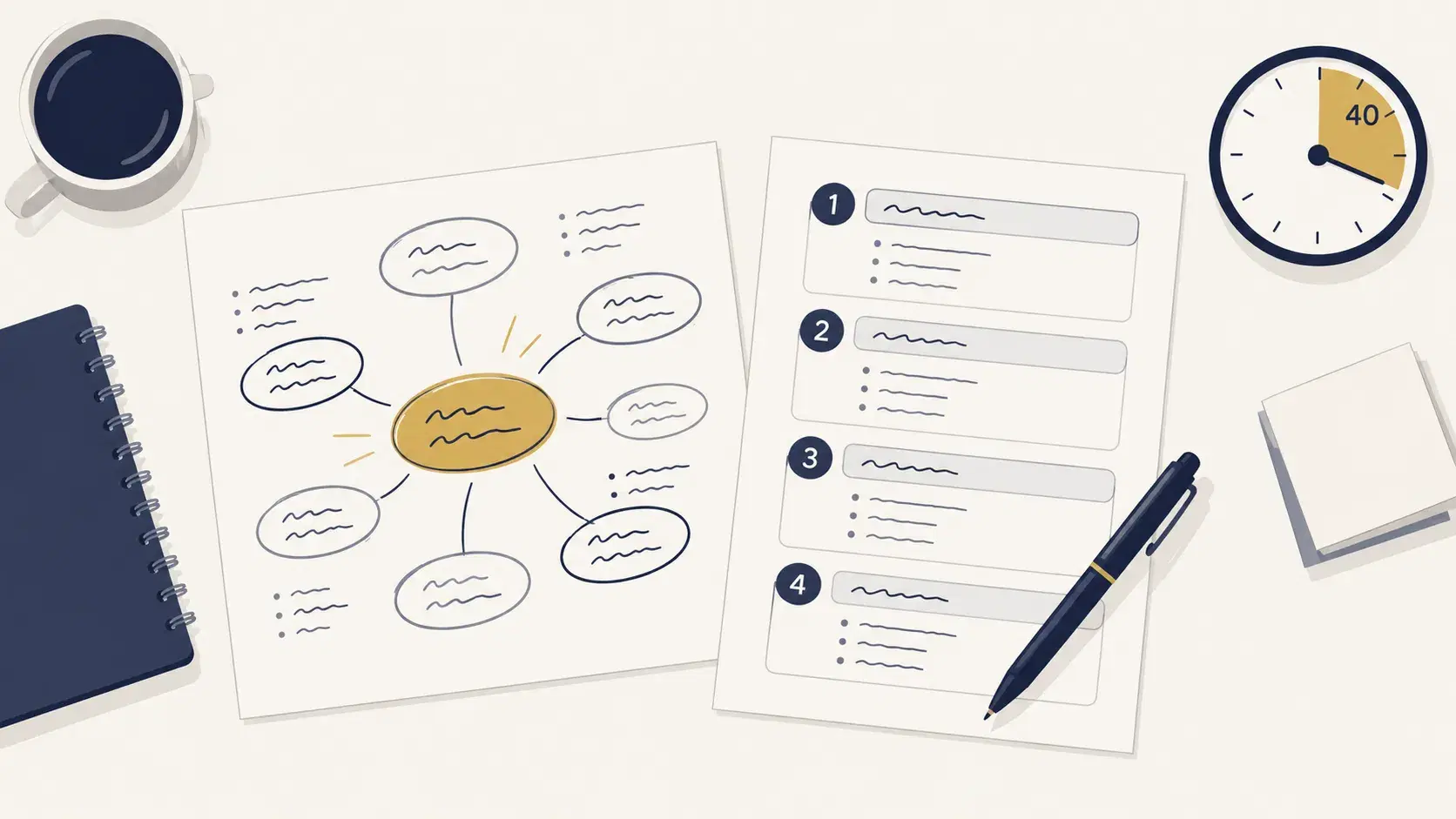
How to Write an IELTS Writing Task 2 Essay: Step-by-Step
A step-by-step method for planning, structuring and writing a strong IELTS Writing Task 2 essay, from an experienced IELTS examiner and prep teacher.
Is a Longer IELTS Writing Task 2 Essay Better?
Does writing more words raise your IELTS Task 2 score? An examiner's look at word count, band descriptors, and why length is not what's being marked.
How IELTS Writing Task 2 Is Scored: An Examiner's Guide
Discover exactly how IELTS Writing Task 2 is scored across all four criteria, with real examiner insight and before-and-after essay examples.
IELTS Reading Techniques: Skimming, Scanning & Timing
Master examiner-approved skimming, scanning and time-management techniques to answer all 40 IELTS Reading questions accurately within the 60-minute limit.
How to Improve Your IELTS Listening Skills Through Practice
Improve your IELTS Listening skills with a listen, investigate, learn, repeat method, plus Zadway's transcript mode with instant word lookup.
Got Band 6? Don't Just Rebook the IELTS Test
Scored Band 6 but need Band 7? Don't just rebook the IELTS test. Learn why retaking alone rarely works, and what to fix first, examiner-style.